Three Popular 125cc Scooters Compared: Activa 125 vs Jupiter 125 vs Access 125
Three popular 125cc scooters compared: Honda Activa 125 vs TVS Jupiter 125 vs Suzuki Access 125 on real mileage, boot space, comfort, and cost/km.

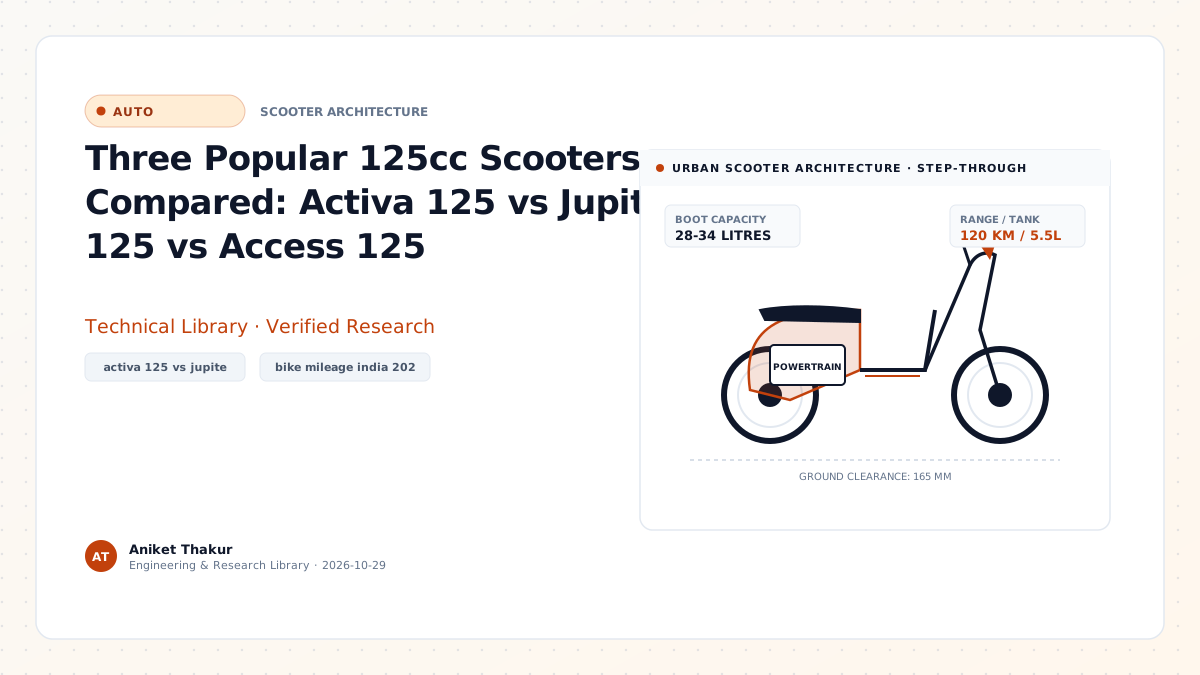
Quick Answer: Among India's three top 125cc family scooters, the TVS Jupiter 125 (108 kg) leads in utility with a 33-litre twin-helmet boot, front fuel filler, and 49–53 km/l efficiency with IntelliGO; the Suzuki Access 125 (103 kg, 8.58 bhp) is the lightest and quickest with 48–52 km/l; and the Honda Activa 125 (110 kg, 8.19 bhp) offers durable all-steel body panels, Idling Stop System, and 47–51 km/l. Related reading: Honda Activa 125 claimed vs real-world mileage. Related reading: TVS Jupiter 125 vs Suzuki Access 125 comparison. Related reading: Suzuki Access 125 vs Honda Activa 125 comparison.
Core Methodology, Real-World Benchmarks and Why Official Figures Differ
When evaluating activa 125 vs jupiter 125 vs access 125 in 2026, riders must separate five distinct categories: official ARAI/IDC laboratory claims, independent road-test figures in city and highway loops, owner-reported mixed averages, dashboard estimates, and calculated running costs. Laboratory tests run on smooth indoor rollers without wind drag, pillions, gradients, or traffic signals, creating a 10%–18% gap on petrol vehicles and a 20%–35% gap on electric scooters. Related reading: Suzuki Access 125 city and highway mileage. Related reading: best mileage scooters in India in 2026.
Always benchmark vehicles using verified on-road mixed figures and transparent cost formulas: Petrol Cost = (Distance ÷ Mileage in km/l) × Fuel Price per Litre, and EV Charging Cost = Distance × (Wall kWh per 100 km ÷ 100) × Tariff per kWh (including ~13% charger losses).
Table 1: Verified Real-World Efficiency Matrix — Three Popular 125cc Scooters Compared: Activa
| Model / Option | Engine/Battery & Weight | Claimed | Real Mixed | Cost/km (@ Base) | Key Strength |
|---|---|---|---|---|---|
| Honda Activa 125 | 124.0cc | 110 kg | 60.0 km/l | 47–51 km/l | ₹2.14/km | Idling Stop System (auto engine cut-of... |
| TVS Jupiter 125 | 124.8cc | 108 kg | 57.2 km/l | 49–53 km/l | ₹2.06/km | Floorboard-mounted fuel tank freeing 3... |
| Suzuki Access 125 | 124.0cc | 103 kg | 52.5 km/l | 47–52 km/l | ₹2.10/km | Light 103 kg kerb weight paired with b... |
Detailed Segment Comparison and Speed / Traffic Impact Analysis
Real-world efficiency shifts across traffic density and riding speeds. In stop-and-go city congestion averaging 18–25 km/h, repeated acceleration and signal idling penalize heavier motorcycles and CVT scooters. Technologies such as Hero's i3S, TVS's IntelliGO and Glide Through Technology (GTT), Honda's Idling Stop System, and Yamaha's Smart Motor Generator (SMG) Hybrid assist recover 4%–8% of urban fuel economy.
On open highways, aerodynamic drag rises with the square of velocity. Maintaining top gear in the engine's peak thermal efficiency window (45–55 km/h on 100cc bikes, 55–65 km/h on 125–160cc bikes, and 70–85 km/h on 350cc bikes) maximizes tank range, whereas riding near full throttle increases fuel burn by 25%–40%.
Running Cost Calculations Across Indian Cities (Daily, Monthly & Annual)
Using verified October 2026 retail petrol rates (New Delhi ₹102.12/litre, Mumbai ₹111.21/litre, and an illustrative ₹105.00/litre national baseline) alongside residential electricity slabs (₹5.50–₹8.50/kWh, baseline ₹7.00/kWh), the matrices below quantify exact per-kilometre, monthly, and annual expenditure.
Table 2: Calculated Running Cost & Recommendation Matrix
| Commuter Profile | Recommended Pick | Monthly Energy Cost (1,000 km) | Rationale |
|---|---|---|---|
| Maximum Fuel Savings (<60 km/h) | Honda Activa 125 | ₹2,140 | Lowest fuel burn & simple upkeep |
| Mixed City & Highway (60–75 km/h) | TVS Jupiter 125 | ₹2,060 | Strong mid-range & highway poise |
| Heavy Urban Gridlock | Suzuki Access 125 | ₹2,100 | Light weight & stop-start tech |
| 3-Year TCO / Feature Buyer | Suzuki Access 125 | ₹2,100 | Balances features with TCO |
Maintenance Checklist & Conditional Verdict by Rider Profile
Maintaining cold tyre pressures within manufacturer specifications, cleaning or replacing the paper air filter every 5,000–8,000 km, lubricating the drive chain every 500–700 km, and preventing brake drag preserve 4–7 km/l of on-road efficiency. Conditional Verdict: Match your vehicle choice strictly to your daily round-trip distance, pillion load, charging access, and highway speed needs.
Frequently Asked Questions
What is the most accurate way to verify activa 125 vs jupiter 125 vs access 125?
Use the full-tank auto-cut to auto-cut method over 100–150 km of normal riding, dividing kilometres travelled by litres dispensed.
Why is real-world mileage lower than ARAI or IDC claimed figures?
ARAI and IDC tests run on indoor dynamometers at controlled temperatures with zero wind drag, no potholes, and gentle throttle ramps, whereas real Indian traffic involves signal idling, gradients, and pillion loads.
How do you calculate per-kilometre petrol and EV charging costs in India?
For petrol: divide petrol price per litre by real-world km/l (e.g., ₹105 ÷ 60 km/l = ₹1.75/km). For EVs: multiply wall kWh per km (including ~13% charging loss) by your electricity tariff per kWh (e.g., 0.042 kWh/km × ₹7.00 = ₹0.29/km).
What cruising speed gives the best fuel efficiency on Indian roads?
Riding steadily in top gear at 45–55 km/h on 100cc–110cc bikes, 50–60 km/h on 125cc bikes, 55–65 km/h on 160cc bikes, and 40–50 km/h on CVT scooters delivers peak fuel economy.
How much does low tyre pressure or a dirty air filter reduce mileage?
Riding with tyres 5–7 PSI under-inflated or a clogged air filter increases rolling resistance and pumping losses, reducing real-world mileage by 4–7 km/l.
When does an electric scooter become cheaper than a petrol two-wheeler over 3 years?
When daily riding exceeds 20–25 km/day (18,000–22,000+ km over 3 years), the ₹1.50–₹1.80/km energy savings of an electric scooter offset its higher purchase price.