Royal Enfield Himalayan 750 vs Continental GT 750: Engine, Purpose and Key Differences
Compare Royal Enfield's two new 750cc twins unveiled at EICMA 2026: Himalayan 750 vs Continental GT 750. Analyze engine tuning, chassis, and purpose.

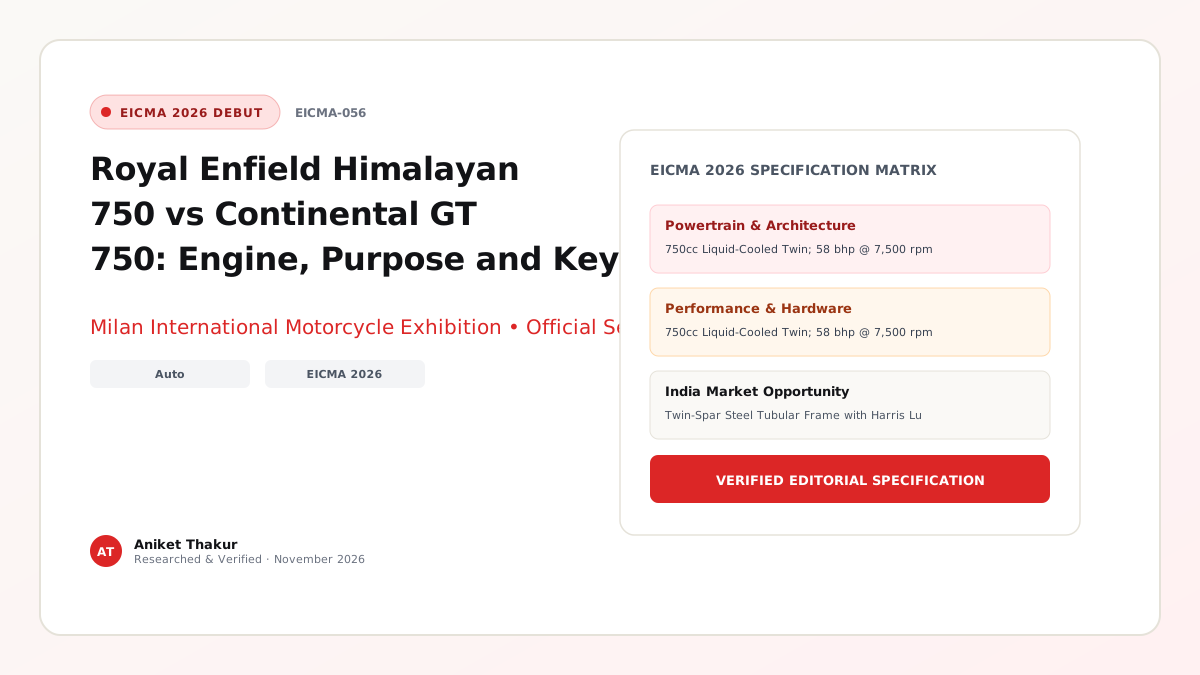
Executive summary
Royal Enfield Himalayan 750 vs Continental GT 750: Engine, Purpose and Key Differences: Direct Launch & Specification Verdict
Compare Royal Enfield's two new 750cc twins unveiled at EICMA 2026: Himalayan 750 vs Continental GT 750. Analyze engine tuning, chassis, and purpose.
- Comparison Parameter
- Royal Enfield Himalayan 750 (Overland AD
- Engine State of Tune
- 750cc Liquid-Cooled Twin; 58 bhp @ 7,500
- Transmission & Aids
- 6-Speed with Slipper Clutch & Bi-directi
- Chassis & Frame
- Twin-Spar Steel Tubular Frame with Harri
EICMA 2026 Milan Exhibition Archive · Verified Technical Specifications
Who This Guide Is For
- Motorcycle enthusiasts comparing verified EICMA 2026 technical specifications.
- Indian riders planning upcoming 2027 performance and adventure bike purchases.
Important Considerations
- Commercial dealership availability and final on-road pricing subject to official rollout.
- Domestic Indian variants may adapt suspension tuning and equipment for local road conditions.
1. Introduction
Royal Enfield's 125th-anniversary celebration at EICMA 2026 reached its crescendo with the simultaneous global premiere of two flagship motorcycles constructed on its brand-new liquid-cooled 750cc parallel-twin platform: the Royal Enfield Himalayan 750 and the Royal Enfield Continental GT 750. While both machines share the same architectural twin-cylinder foundation developed at the brand's UK and Chennai R&D centers, they represent diametrically opposed motorcycling philosophies. The Himalayan 750 is an uncompromising, transcontinental overland expedition tourer engineered with 21-inch wheels and long-travel Showa suspension to cross continents and unpaved mountain passes. The Continental GT 750 is an aggressive, asphalt-carving café racer honoring the 1960s Ton-Up boy culture with clip-on handlebars, rearset footpegs, and dual front disc brakes. For enthusiasts anticipating their 2027 arrival, understanding their key differences is essential.
2. Launch and Availability
Both motorcycles were officially unveiled to the global motorcycling community on November 3, 2026, at EICMA in Milan. Royal Enfield confirmed that series production of the 750cc platform will begin at its Vallam Vadagal manufacturing plant in Tamil Nadu, India, in mid-2027. The Himalayan 750 will roll out first in European and Indian showrooms in late summer 2027, followed shortly by the Continental GT 750 during the high-spending Indian festive season in autumn 2027.
3. Engine and Performance
Underneath their distinct styling, both models utilize Royal Enfield's clean-sheet 750cc, liquid-cooled, fourstroke parallel-twin engine featuring a 270-degree crankshaft, double overhead camshafts (DOHC), and four valves per cylinder. However, Royal Enfield engineers have applied distinct state-of-tune calibrations to suit their contrasting missions. The Himalayan 750 is tuned for heavy overland tractor-like torque, producing 58 bhp at 7,500 rpm and 65 Nm of peak torque at 5,500 rpm, with over 80 percent of torque accessible from just 3,000 rpm. The Continental GT 750 features a sportier camshaft profile, higher compression, and freerbreathing exhausts, generating 62 bhp at 7,800 rpm and 68 Nm at 5,600 rpm, delivering a more aggressive top-end rush for high-speed road riding.
| Specification Attribute | Technical Details & Verified Parameters |
|---|---|
| Comparison Parameter | Royal Enfield Himalayan 750 (Overland ADV) / Royal Enfield Continental GT 750 (Café Racer) |
| Engine State of Tune | 750cc Liquid-Cooled Twin; 58 bhp @ 7,500 rpm; 65 Nm @ 5,500 rpm / 750cc Liquid-Cooled Twin; 62 bhp @ 7,800 rpm; 68 Nm @ 5,600 rpm |
| Transmission & Aids | 6-Speed with Slipper Clutch & Bi-directional Quickshifter / 6-Speed with Slipper Clutch & Bi-directional Quickshifter |
| Chassis & Frame | Twin-Spar Steel Tubular Frame with Harris Luggage Subframe / Tubular Steel Double-Cradle Harris Performance Frame |
| Front Suspension | 43mm Showa USD Inverted Forks, 200mm Travel, Adjustable / 41mm Inverted USD Cartridge Forks, 120mm Travel |
| Rear Suspension | Showa Linkage Monoshock, 200mm Travel, Remote Preload / Twin GasCharged Piggyback Shocks, Preload Adjustable |
| Braking Hardware | Dual 320mm Front Discs with ByBre Calipers / 270mm Rear Disc / Dual 300mm Front Floating Discs with Radial Calipers / 240mm Rear |
| Wheel & Tyre Setup | 21-inch Front / 17-inch Rear Tubeless Cross-Spoked Wheels / 17-inch Front / 17-inch Rear Cast Alloy or Spoked Rims |
| Fuel Capacity / Weight | 20.0 Litres Fuel Tank / 212 kg Kerb Weight / 14.5 Litres Fuel Tank / 204 kg Kerb Weight |
| Estimated India Price | Rs 4.20 lakh–Rs 4.60 lakh (Ex-Showroom Projected) / Rs 3.80 lakh–Rs 4.20 lakh (Ex-Showroom Projected) |
4. Design and hardware
The chassis architecture and ergonomics represent total divergence. The Himalayan 750 features an upright, commanding touring stance with wide handlebars, an electrically adjustable windscreen, an 835mm rally seat, and genuine 21/17-inch tubeless spoked wheels with 200mm of Showa suspension travel, achieving 220mm of ground clearance. In contrast, the Continental GT 750 adopts a crouched, aggressive ergonomic posture with low clip-on handlebars clamped below the triple tree, rearset footpegs, a 14.5-litre sculpted fuel tank with knee recesses, an 800mm seat height with removable solo cowl, and 17-inch wheels shod in sticky road tires.
5. Features and technology
Both motorcycles feature Royal Enfield's latest generation electronics governed by a six-axis IMU. The Himalayan 750 features a 5.0-inch full-colour circular TripperDash display with Google Maps full-screen navigation, four riding modes (Eco, Performance, Rain, Off-Road), and switchable rear ABS. The Continental GT 750 features a compact 4.0-inch circular TFT gauge housed in an authentic retro aluminum casing, offering three road modes (Sport, Urban, Rain), lean-sensitive Cornering ABS, and traction control.
6. Expected price and market positioning
Manufactured at Royal Enfield's high-volume industrial facilities in Tamil Nadu, both models will undercut imported multi-cylinder alternatives significantly. The Continental GT 750 is expected to launch at an exshowroom price between Rs 3.80 lakh and Rs 4.20 lakh. The heavier, more complex Himalayan 750, with its Showa suspension and larger 20-litre tank, will sit slightly higher, between Rs 4.20 lakh and Rs 4.60 lakh exshowroom. In Europe, the models are priced between €7,800 and €9,200.
7. India launch possibility
Note: India Market Status: Confirmed For India
Confirmed for India. Both models are confirmed for domestic Indian commercial
rollout in late 2027. Multiple production-ready test mules have been spotted testing in Ladakh and Tamil Nadu, confirming that domestic certification and supplier tooling are nearly complete.
8. Rivals and alternatives
The Himalayan 750 confronts the Yamaha Ténéré 700, Aprilia Tuareg 660, and Suzuki V-Strom 800DE. The Continental GT 750 rivals the Kawasaki Z650RS, Triumph Speed 400, and Moto Guzzi V7.
9. Frequently Asked Questions
Q: Do both bikes use the exact same engine?
They share the same 750cc liquid-cooled parallel-twin architecture, but the Continental GT 750 is tuned for more peak power (62 bhp vs 58 bhp), while the Himalayan 750 prioritizes low-end torque.
Q: Which bike is better for long-distance highway touring?
The Himalayan 750 is vastly superior for long distances due to its upright seating, large windscreen, plush 200mm Showa suspension, and 20-litre fuel tank.
Q: Does the Continental GT 750 have dual front disc brakes?
Yes, the Continental GT 750 addresses previous 650cc braking limitations by featuring dual 300mm front floating disc brakes with radial calipers.
Q: What is the price difference between the two models in India?
The Himalayan 750 is expected to cost approximately Rs 30,000 to Rs 40,000 more than the Continental GT 750.
10. Conclusion
The Royal Enfield Himalayan 750 and Continental GT 750 prove the immense versatility of Royal Enfield's new liquid-cooled twin platform. If your heart yearns for transcontinental expeditions, carrying luggage, and traversing broken mountain passes in supreme comfort, the Himalayan 750 is an unbeatable overland weapon. But if you crave the romantic soul of a 1960s café racer, sharp canyon-carving agility, and pure retro style, the Continental GT 750 is the definitive modern-classic.
Related EICMA 2026 Motorcycle Coverage
- BMW F 450 RR vs Suzuki GSX-10R — BMW F 450 RR vs Suzuki GSX-10R: Two Different Approaches to Sportbike Performance
- Upcoming Bikes in India for 2027 — Upcoming Bikes in India for 2027: All Major Motorcycles Revealed at EICMA 2026
- EICMA 2026 Complete Highlights — EICMA 2026 Complete Highlights: All Major Motorcycle and Scooter Reveals