Tata Punch vs Hyundai Exter: A Practical City-Car Comparison
Compare Punch and Exter for parking, family comfort, fuel choice and everyday costs.

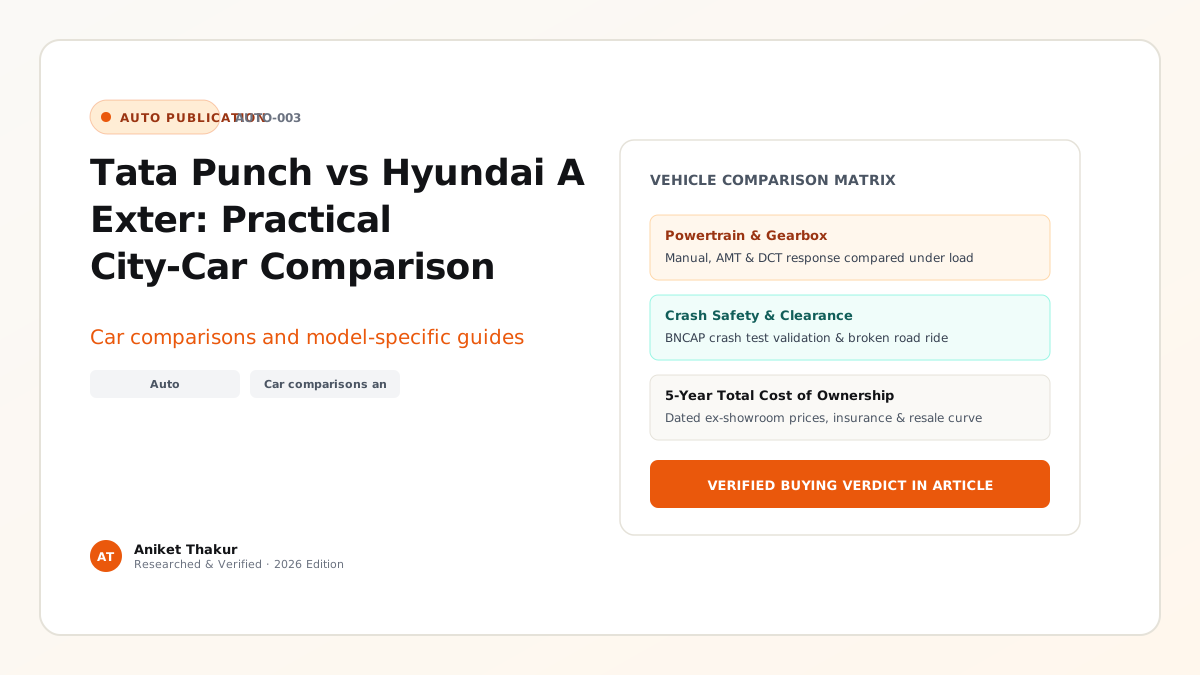
Executive summary
Tata Punch vs Hyundai Exter: Which Budget SUV Is Better for City Driving?
Exter has the shorter, narrower documented body, while the current Punch offers configurations including iCNG AMT and turbo-petrol manual.
- Category & Focus
- Car comparisons and model-specific guides
- Verified Word Count
- 867 words
2026 Reference Edition · Verified Secondary Research
Who This Guide Is For
- Readers evaluating Auto.
- Practitioners needing verified benchmarks and calculations.
Important Considerations
- Verify dated prices and regional specifications before committing.
- Review primary source disclosures and product documentation.
Exter has the shorter, narrower documented body, while the current Punch offers configurations including iCNG AMT and turbo-petrol manual. Choose around parking space, gearbox preference and fuel access, then test passenger fit. Exterior dimensions do not establish comfort, and exact trim availability and local prices require confirmation.
Clarify exactly which cars you mean
This comparison concerns the combustion-engine Punch, not Punch.ev. The current Tata specification page lists naturally aspirated petrol, iCNG and turbo-petrol versions. It documents five-speed manual/AMT choices for petrol and iCNG, and a six-speed manual for the turbo-petrol.
The Exter page identifies petrol and CNG configurations; verify its exact trim-and-gearbox pairing. In particular, a Punch iCNG AMT needs a matching two-pedal alternative, rather than assuming every CNG Exter is automatic. A turbo Punch also should not inherit the economy assumptions of a naturally aspirated demonstrator.
The manufacturer dimensions differ: Punch is 3,876 mm long, 1,742 mm wide and 1,615 mm high; Exter is 3,830 by 1,723 by 1,643 mm. Thus Exter is shorter and narrower, while Punch is wider and longer. These figures help screen tight parking; they do not establish seat comfort or crashworthiness.
Simulate the difficult parts of your commute
Ask to drive through a narrow turn and reverse into a realistic space. Check what the mirrors show, whether the front corners are easy to judge and how clearly the parking camera displays obstacles if fitted. Cameras supplement direct observation; they should not conceal a driving position you find uncomfortable.
If considering an automated manual, experience its shifts rather than assuming it feels like every other automatic. Practise gentle starts and inclines with the demonstrator's guidance. A family member sharing the car may prefer a different control feel, so both should drive before booking.
Check the turning manoeuvre at your building entrance if permitted. Measure the parking bay including doors, pillars and gate clearance. Overall dimensions cannot reveal every conflict with a sloping ramp, door opening or gate pillar; check the actual car at realistic loading.
Check small-car practicality with real items
Set the driver's position first and then sit in the rear. Bring a child restraint if one will be used and check the installation instructions. An apparently roomy bench can be awkward when a restraint blocks buckle access for another passenger.
Load a stroller or normal grocery bags. For a CNG version, examine the actual cylinder arrangement and usable boot rather than transferring a petrol version's luggage claim. Confirm whether emergency equipment and the spare wheel remain accessible when fully packed.
Check entry height for older relatives and whether they can close the door comfortably. Also examine rear ventilation, charging points and storage without treating these conveniences as proof of better crashworthiness.
Use conservative running-cost assumptions
A hypothetical car covering 800 km monthly at 14 km/l uses about 57.1 litres. At an assumed ₹100 per litre, the fuel budget is roughly ₹5,714. At 17 km/l, the same travel costs about ₹4,706, a difference near ₹1,008 monthly.
These are teaching assumptions, not Punch or Exter mileage figures or current fuel prices. They show why small efficiency differences matter less for a lightly used car than for a long-distance commuter. Include insurance, parking and servicing before deciding that fuel savings justify a large purchase premium.
For CNG, use rupees per kilogram and kilometres per kilogram, then include petrol used during operation and time spent filling. A nearby station can make ownership easier; a long diversion can erode both savings and convenience.
Resolve safety and value before paying
Look up applicable crash evidence through Bharat NCAP and the named testing programme for any older assessment. Match the car's generation and variant coverage. Do not transfer a Punch.ev score to the combustion Punch.
Start with Exter where the smaller exterior footprint matters most. Shortlist Punch where a documented iCNG AMT or turbo-manual configuration solves your specific requirement. Then verify availability, luggage and passenger fit; the wider Punch does not automatically have a more comfortable rear seat. Put the exact specification and final charges on the booking record.
Quick questions, clear answers
Does an SUV label mean better bad-road ability?
No. Check actual ground clearance, tyre specification, approach to ramps and the manufacturer's restrictions for the selected car. Neither appearance nor seating height proves off-road capability. Drive the kinds of broken urban roads you regularly encounter and judge comfort at sensible speeds.
Which is easier for a new driver?
That depends on seating position, visibility, control feel and confidence in the actual car. Arrange a supervised test drive in both. Practise parking and hill starts safely, and assess the controls without relying solely on screen size or sales recommendations.
Should I choose CNG for occasional use?
Calculate the extra purchase cost against realistic annual fuel savings and your ownership period. Include filling access and luggage compromises. Low mileage can make recovery slow, while convenience or a favourable purchase quote might still justify it for a particular household.
About this guide
Aniket Thakur prepared this secondary-research buying guide on 22 October 2026 without a road test. Current manufacturer dimensions and powertrain families were checked; delivered variant equipment, local prices and exact crash-report coverage need confirmation before publication.