Yamaha Y-AMT Explained: How Automated Manual Transmission Works on the RW700
Comprehensive technical guide to Yamaha's Y-AMT automated manual transmission debuted on the RW700 at EICMA 2026: actuators, paddle shifts, and auto modes.

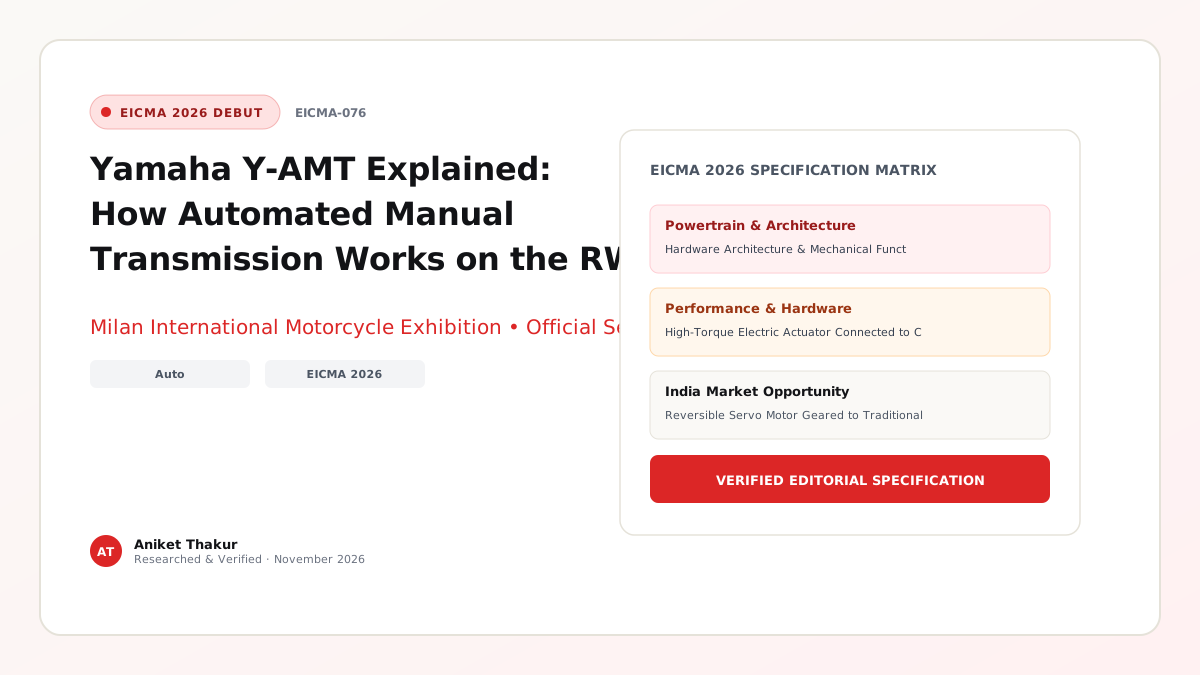
Executive summary
Yamaha Y-AMT Explained: How Automated Manual Transmission Works on the RW700: Direct Launch & Specification Verdict
Comprehensive technical guide to Yamaha's Y-AMT automated manual transmission debuted on the RW700 at EICMA 2026: actuators, paddle shifts, and auto modes.
- Y-AMT Technical Compon
- Hardware Architecture & Mechanical Funct
- Clutch Stepper Motor A
- High-Torque Electric Actuator Connected
- Shift Drum Actuator
- Reversible Servo Motor Geared to Traditi
- Total Subsystem Mass
- Complete Actuator & Electronic Wiring Pa
EICMA 2026 Milan Exhibition Archive · Verified Technical Specifications
Who This Guide Is For
- Motorcycle enthusiasts comparing verified EICMA 2026 technical specifications.
- Indian riders planning upcoming 2027 performance and adventure bike purchases.
Important Considerations
- Commercial dealership availability and final on-road pricing subject to official rollout.
- Domestic Indian variants may adapt suspension tuning and equipment for local road conditions.
1. Introduction
One of the most consequential technological breakthroughs unveiled at EICMA 2026 was the application of Yamaha's newly refined Y-AMT (Yamaha Automated Manual Transmission) onto the adventure-crossover platform of the all-new 2027 Yamaha RW700. For over a century, traditional motorcycling has demanded physical multitasking: coordinating the left-hand clutch lever, left-foot gear selector, and right-hand throttle. While traditional continuously variable transmissions (CVTs) simplified riding on urban scooters, they suffered from elastic 'rubber-band' throttle lag, parasitic frictional losses, and a disconnected mechanical feel. Automated dual-clutch systems (like Honda's DCT), while brilliant, added up to 10 kg of mechanical weight and increased engine bulk. With Y-AMT, Yamaha has engineered an ingenious middle way: a featherweight electro-mechanical system that automates clutch actuation and gear shifting on a conventional constantmesh gearbox, weighing a minuscule 2.8 kg while providing the rider with instant fingertip control.
2. Launch and Availability
Yamaha officially detailed the latest evolution of Y-AMT during its global technical presentation at EICMA on November 3, 2026, in Milan. The system will enter global commercial distribution as standard equipment on the RW700 adventure scooter and optional equipment across Yamaha's CP2 and CP3 motorcycle ranges starting in May 2027. Yamaha confirmed that Y-AMT will be deployed across multiple international markets, with Indian availability under active evaluation for late 2027.
3. Engine and Performance
Y-AMT works in complete synergy with Yamaha's 689cc crossplane parallel-twin CP2 engine, producing 73.4 hp at 8,750 rpm and 68 Nm of torque at 6,500 rpm. The mechanical gearbox inside the crankcases remains a conventional six-speed constant-mesh transmission with traditional dog gears and a multi-plate wet clutch. However, all external manual levers—the left handlebar clutch lever and the left foot gear shifter—are completely eliminated. In their place, Yamaha has mounted two high-speed electric stepper-motor actuators externally on the engine casings: one commanding the clutch pushrod, and the other rotating the gear selector drum.
| Specification Attribute | Technical Details & Verified Parameters |
|---|---|
| Y-AMT Technical Component | Hardware Architecture & Mechanical Function / Operational Benefit to Rider |
| Clutch Stepper Motor Actuator | High-Torque Electric Actuator Connected to Clutch Release Rod / Engages and slips clutch automatically from 0 rpm; stall-proof operation |
| Shift Drum Actuator | Reversible Servo Motor Geared to Traditional Shift Drum / Executes full gear shifts in under 0.1 seconds, faster than manual human shifts |
| Total Subsystem Mass | Complete Actuator & Electronic Wiring Package Weighed at 2.8 kg / Adds minimal weight (compared to Honda DCT's ~10 kg penalty) |
| Manual (MT) Mode | Handlebar-Mounted Seesaw Toggle Switch (+ and - Paddles) / Allows lightning-fast index-finger upshifts and thumb downshifts |
| Automatic (D) Mode | City-Optimized Shift Map Prioritizing Low RPM and Fuel Economy / Smooth, relaxed commuting with seamless automatic gear transitions |
| Automatic (D+) Mode | Sport-Optimized Shift Map Holding Gears Higher into Rev Range / Aggressive throttle downshifts and active corner-entry engine braking |
| Stall-Prevention Logic | Automatic Clutch Disengagement Below Engine Idle Speed / Allows the motorcycle to come to a dead stop in gear without stalling |
4. Design and hardware
The ergonomic transformation brought by Y-AMT is revolutionary. Without a clutch lever on the left handlebar, Yamaha has relocated the rear brake control to the left handlebar lever (as on a traditional scooter), creating an intuitive, bicycle-like braking layout that allows riders to brake with immense sensitivity using both hands. Gear selection in Manual (MT) mode is commanded by a tactile seesaw rocker switch located conveniently beside the left thumb. Pulling the '+' lever with the index finger initiates instantaneous upshifts, while pushing the '-' button with the thumb executes rapid downshifts with automated rev-matching blips.
5. Features and technology
Y-AMT's intelligence is governed by a dedicated Transmission Control Unit (TCU) that communicates at millisecond speeds with the engine ECU and six-axis IMU. Riders can switch between Manual (MT) and Automatic (AT) modes on-the-fly via a dedicated right handlebar switch. In Automatic mode, riders can choose between 'D' mode (for relaxed commuting and maximum fuel efficiency) and 'D+' mode (for spirited canyon carving, which holds gears aggressively near peak torque and downshifts early to provide engine braking into turns). In Manual mode, the system never shifts automatically unless the rider slows to a complete stop, where it downshifts to 1st gear to prevent stalling.
6. Expected price and market positioning
Because Y-AMT utilizes a conventional motorcycle gearbox rather than expensive twin-clutch assemblies or complex hydraulic pumps, Yamaha has achieved remarkable cost efficiency. In European showrooms, Y-AMT adds a modest €500 premium over equivalent manual models, substantially undercutting DCT systems (€1,200 premium). Yamaha positions Y-AMT as the definitive transmission of the future, appealing equally to veteran sport riders seeking faster track lap times and newer riders intimidated by manual clutch coordination.
7. India launch possibility
Note: India Market Status: Possible But Unconfirmed
Possible but unconfirmed. Yamaha India is closely analyzing customer
response to Y-AMT. With Indian urban traffic congestion reaching extreme levels, an automated transmission that eliminates clutch-hand fatigue while preserving direct-drive gear acceleration is the holy grail for Indian commuter tourers. If Yamaha introduces the RW series or MT-07 to India in late 2027, Y-AMT will serve as a premier commercial differentiator.
8. Rivals and alternatives
Yamaha's Y-AMT competes directly against Honda's Dual Clutch Transmission (DCT) and Honda's electronic E-Clutch, as well as BMW's Automated Shift Assistant (ASA). Y-AMT holds a decisive advantage over DCT in weight (saving over 7 kg) and simplicity, while providing a more fully automated experience than Honda's EClutch (which still requires manual foot shifting).
9. Frequently Asked Questions
Q: Can a Y-AMT motorcycle stall in traffic?
No, the electronic TCU automatically disengages the clutch when vehicle speed or engine rpm drops near idle, making it completely impossible to stall.
Q: Does Y-AMT have a clutch lever on the handlebar?
No, the manual clutch lever is completely eliminated. On scooters like the RW700, the left handlebar lever operates the rear brake.
Q: How fast does Y-AMT shift gears?
Y-AMT executes a full mechanical gear shift in less than 0.1 seconds, faster and more consistently than professional human racers.
Q: Can I shift manually in automatic mode?
Yes, even in 'D' or 'D+' automatic modes, riders can manually override the gear selection at any moment using the handlebar paddle switches.
10. Conclusion
The Yamaha Y-AMT transmission showcased on the RW700 at EICMA 2026 is an absolute triumph of motorcycle engineering. By eliminating clutch-hand fatigue without adding heavy mechanical bulk or dulling the crisp, direct mechanical connection of a real gearbox, Yamaha has unlocked a new dimension of riding freedom, speed, and comfort. It represents the future of motorcycle transmissions.
Related EICMA 2026 Motorcycle Coverage
- Suzuki S.I.R.S. Explained — Suzuki S.I.R.S. Explained: New Electronic Features on the GSX-10R
- Best Middleweight Motorcycles at EICMA 2026 — Best New Middleweight Motorcycles Revealed at EICMA 2026
- Upcoming Bikes in India for 2027 — Upcoming Bikes in India for 2027: All Major Motorcycles Revealed at EICMA 2026
- Top 10 Motorcycle Tech Developments at EICMA 2026 — Top 10 Biggest Motorcycle Technology Developments Revealed at EICMA 2026