CAGR vs Absolute Returns: How to Calculate Investment Returns in Excel
Calculate CAGR and absolute returns in Excel, with examples and important limits.

Executive summary
CAGR vs Absolute Returns: How to Calculate Investment Returns in Excel: Key Verdict & Summary
Absolute return measures the total gain or loss; CAGR converts the same beginning and ending values into an equivalent annual compounded rate.
- Category & Focus
- Personal finance and investing
- Verified Word Count
- 798 words
2026 Reference Edition · Verified Secondary Research
Who This Guide Is For
- Readers evaluating Personal finance and investing.
- Practitioners needing verified benchmarks and calculations.
Important Considerations
- Verify dated prices and regional specifications before committing.
- Review primary source disclosures and product documentation.
Absolute return measures the total gain or loss; CAGR converts the same beginning and ending values into an equivalent annual compounded rate. Use both for a single investment with no intervening contributions. If you added or withdrew money, a dated cash-flow calculation such as XIRR is usually more informative.
Two questions, two formulas
Absolute return answers: how much did the investment grow overall? Calculate (Ending value / Beginning value) - 1. CAGR answers: what constant yearly growth rate would connect those values? Calculate (Ending value / Beginning value)^(1/Years) - 1.
Neither formula says what happened along the way. An investment might double smoothly or experience a severe fall before recovering. CAGR describes the endpoints, not the route. It also assumes that distributions are appropriately included, rather than quietly treating a dividend-paying investment as a price-only investment.
The SEC investor introduction distinguishes price gains from interest and dividend income. Record all components of the return before choosing a calculation. Comparing a total-return figure with a price-return figure produces a misleading comparison even when both formulas are mathematically correct.
Build the Excel calculation
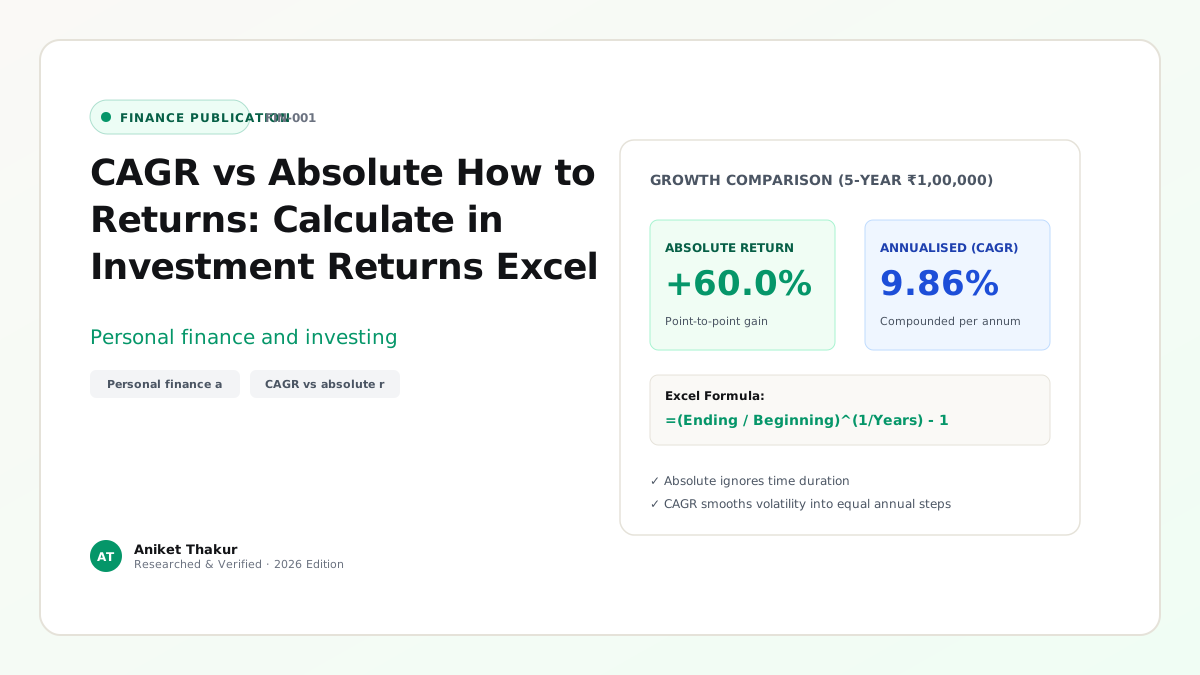
Consider a hypothetical investment of ₹1,00,000 that becomes ₹1,60,000 after five years, with no cash added, removed or separately distributed. Put the starting value in B2, ending value in B3 and years in B4.
Enter =B3/B2-1 for absolute return. The result is 60%. Enter =(B3/B2)^(1/B4)-1 for CAGR. The result is approximately 9.86%. Format both cells as percentages; otherwise Excel displays decimals such as 0.60.
Do not divide 60% by five and call the resulting 12% CAGR. That calculation ignores compounding. At 12% compounded for five years, ₹1,00,000 would grow to about ₹1,76,234, which does not match the actual ending value in this illustration.
For an exact dated interval, define the annualisation convention explicitly. One transparent approximation is =(B3/B2)^(365/(B6-B5))-1, where B5 and B6 contain real Excel start and end dates. It uses a 365-day year. A calendar-year convention may differ slightly around leap years.
When CAGR hides something important
Suppose the account begins with ₹1,00,000 and ends with ₹1,60,000, but you contribute another ₹50,000 halfway through. Treating the entire ending balance as growth on the original deposit overstates performance. The account value rose partly because you supplied additional capital.
Create a cash-flow ledger instead: contributions are negative, withdrawals positive, and the final portfolio valuation is a positive terminal flow. Microsoft documents XIRR for payments that are not necessarily periodic. Dates and signs must be consistent; the closing value is included even if you have not sold the investment.
CAGR can also exaggerate the impression created by short periods. A strong three-month gain annualised over a full year is a mathematical extrapolation, not a forecast. Describe the observed period prominently and avoid presenting that annualised figure as an expected annual return.
Compare investments on a consistent basis
Write a small comparison checklist beside the model. Are the dates identical? Are costs already deducted? Are dividends reinvested? Is the figure before or after tax? Are both investments expressed in rupees? Each answer can materially change the interpretation.
For a practical report, show starting capital, ending value, elapsed time, absolute return and CAGR together. Add maximum drawdown or annual returns if reliable history is available. A five-year CAGR alone cannot tell a reader whether the investment might have been unsuitable for a near-term goal.
Check the formula by rebuilding the ending value: =B2*(1+CAGR_cell)^B4. It should reproduce B3 apart from rounding. Keep unrounded rates in calculations and round only the displayed results. This simple reverse calculation catches incorrect year counts and percentage formatting errors.
Quick questions, clear answers
Can CAGR be negative?
Yes. If a positive starting investment finishes lower after a positive holding period, CAGR is negative. A zero ending value corresponds to a complete loss. Negative starting values or some negative ending values do not fit the ordinary investment CAGR interpretation and require a different analysis.
Is CAGR the same as an average annual return?
It is a geometric annualised rate, not the arithmetic mean of yearly returns. A 50% rise followed by a 50% fall leaves capital 25% lower, although the arithmetic mean is zero. Compounding requires multiplying growth factors rather than averaging percentages.
Which figure should a beginner report?
Report absolute return and the holding period first, then CAGR where the period and cash-flow pattern justify it. For SIPs or irregular investments, add XIRR. None of these figures establishes whether an investment is low risk or appropriate for a particular person.
About this guide
Aniket Thakur prepared this educational guide from secondary research checked on 22 October 2026. All numerical illustrations are hypothetical unless stated otherwise. No investment product was tested, and no individual financial circumstances were assessed. Read the cited primary material and relevant product documents before acting.