Product Manager Interview Preparation: Product Sense, Metrics and Strategy Cases

Ace your Product Manager interview across Product Sense (CIRCLES), Execution & Metrics, Strategy, Estimation, and Behavioral rounds with a full worked case.
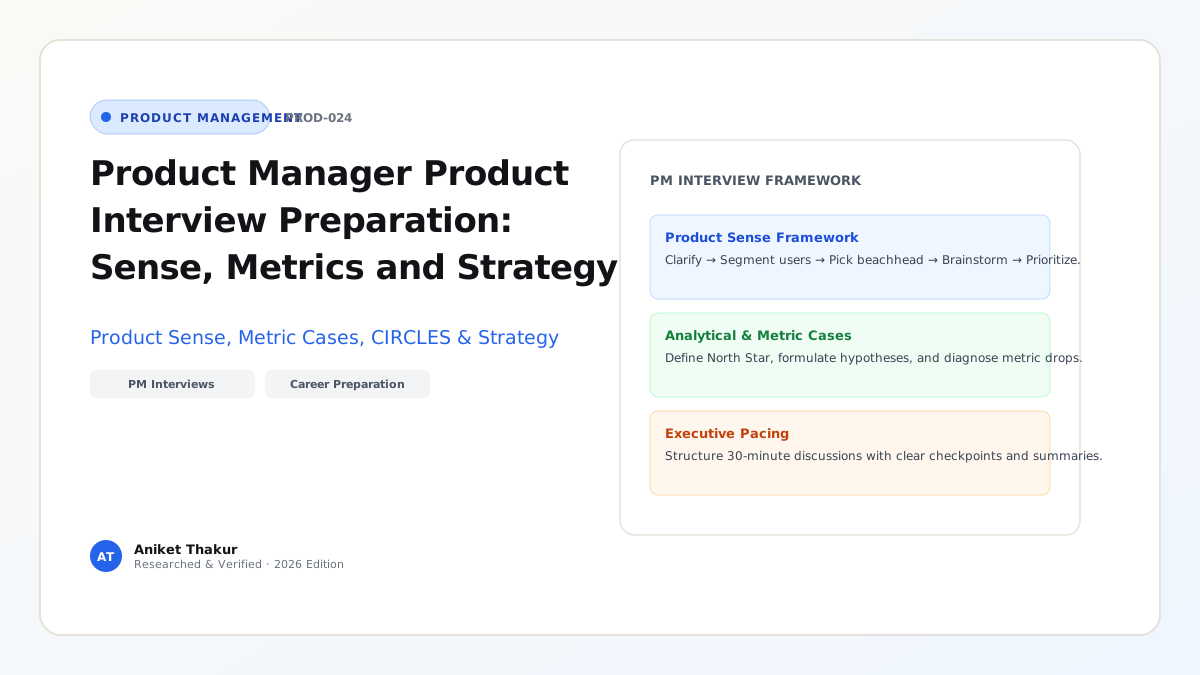
Product Manager interview loops are among the most rigorous in the technology industry because they do not test memorized syntax—they test how you structure ambiguity in real time. In a span of four 45-minute back-to-back sessions, a candidate may be asked to design an audio learning product for commuters (Product Sense), define the North Star Metric and diagnose a 15% conversion drop for a fintech app (Execution & Metrics), decide whether a B2B SaaS company should enter the payments space (Product Strategy), estimate the cloud storage & LLM inference cost of an AI feature (Estimation & Technical), and recount resolving an executive deadlock (Behavioral Leadership).
Why do so many smart candidates fail these loops even after reading interview prep books? They fail for two opposite reasons: either they jump straight into brainstorming random solutions at Minute 2 without clarifying the business goal or segmenting users, or they recite memorized acronyms robotically ("Now I am moving to the 'R' in CIRCLES to Report Customer Needs"), sounding like a textbook checklist rather than a thoughtful product collaborator. This guide breaks down the exact scoring rubric interviewers use behind the scenes across all five interview archetypes, shows how to apply Lewis C. Lin's CIRCLES Method (ProductPlan CIRCLES Glossary) naturally, and walks through a complete, timed, annotated mock case combining Product Design and Fermi Estimation.
1. Round 1: Product Sense & Product Design (Adapting the CIRCLES Method Naturally)
A Product Sense / Design prompt (e.g., "Design a financial literacy product for Gen-Z first-time earners" or "How would you improve Google Maps for electric vehicle drivers?") evaluates whether you can narrow a massive, ambiguous space down to a sharp user problem and invent a differentiated solution.
Created by Lewis C. Lin (ProductPlan CIRCLES Method and Productfolio CIRCLES Guide), the CIRCLES Method™ provides the logical backbone for a 35-minute design case—provided you internalize the flow and never announce the acronym letters out loud:
- C — Comprehend the Situation (Minutes 0–4): Clarify the scope, company context (startup vs. incumbent), platform constraints, and explicitly lock the primary business objective (e.g., user acquisition, engagement depth, or monetization) with the interviewer.
- I — Identify the Customer (Minutes 4–9): Brainstorm 3 to 4 distinct behavioral user segments (never generic age brackets like "18–25 vs 26–40"; use behavioral contexts like "Gig-economy EV delivery riders driving 180 km/day" vs "Weekend family road-trippers with range anxiety"). State an explicit criterion (Reach $\times$ Pain Severity) to pick 1 beachhead segment.
- R — Report the Customer's Needs / Pain Points (Minutes 9–14): Walk chronologically through your chosen segment's Customer Journey (Article 12) and identify 3 acute pain points / unmet Jobs to Be Done.
- C — Cut, Through Prioritization (Minutes 14–16): Score the 3 pain points explicitly across Frequency $\times$ Severity of Pain $\times$ Underserved Gap to pick the #1 problem to solve first.
- L — List Solutions (Minutes 16–24): Brainstorm 3 distinct solutions spanning increasing levels of ambition (e.g., Solution A: Pragmatic workflow integration; Solution B: Ecosystem/data network play; Solution C: High-leverage AI/predictive capability). Avoid listing 3 tiny variations of a settings button.
- E — Evaluate Trade-Offs & Prioritize MVP (Minutes 24–30): Score your 3 solutions using Impact vs. Engineering Effort (RICE) and explicitly state the downside risks and failure modes of your winning choice (interviewers love candidates who critique their own solution before being prompted!).
- S — Summarize & Define Success Metrics (Minutes 30–35): Deliver a crisp 60-second recap: Target Persona $\rightarrow$ Core Problem $\rightarrow$ MVP Solution $\rightarrow$ Primary North Star & Guardrail Metric (Article 17).
2. Round 2: Execution, Product Metrics & Root-Cause Diagnosis
Execution interviews usually split into two 20-minute halves:
- Part A — Metric Definition ("How would you measure success for Feature X?"): Use the Game $\rightarrow$ North Star $\rightarrow$ Funnel Inputs $\rightarrow$ Guardrails structure from Article 17. State the product's core value exchange, define 1 North Star Metric, list 3 input metrics (Activation, Engagement Depth, Retention), and always finish by naming 2 Guardrail Counter-Metrics (e.g., latency, cannibalization of core revenue, or spam/churn rate).
- Part B — Metric Drop Diagnosis ("Metric Y dropped 15%—what do you do?"): Apply the 7-Step Diagnostic Framework from Article 21 systematically: (1) Verify formula & telemetry integrity, (2) Check seasonality/macro, (3) Isolate the horizontal funnel step, (4) Slice vertically by Platform/Geo/Tenure/Channel (checking for Simpson's Paradox), and (5) Correlate with code deploys, A/B experiments, and third-party APIs.
3. Round 3: Product Strategy, Market Entry & Pricing Cases
Strategy prompts ("Should Notion build a native CRM?" or "How should an AI coding startup defend its moat against foundation model providers?") test the 5-Question Strategy Framework from Article 06:
- Market & Trends: How is customer behavior or unit cost shifting over the next 2–3 years?
- Customer & Unmet Job: Which segment is underserved by incumbents?
- Company Strengths & Synergies: Does the company possess a proprietary distribution channel, data loop, or workflow adjacency that gives it an unfair right to win?
- Economic Moat & Unit Economics: Will this expand Net Revenue Retention (NRR) and maintain healthy gross margins, or will it drag the company into low-margin services?
- Explicit Recommendation & Pre-Mortem Risk: Make a decisive call ("Yes, enter via a lightweight PLG template wedge for <50-employee startups, while explicitly avoiding enterprise Salesforce displacement in Year 1").
4. Round 4: Fermi Estimation, Technical Literacy & Behavioral (STAR + Learning)
- Fermi Estimation Cases: ("Estimate the monthly LLM token and storage cost for WhatsApp AI voice-note summaries in India.") Interviewers do not grade whether you know the exact census decimal; they grade whether you build a clean Top-Down or Bottom-Up equation tree, state sensible rounded assumptions out loud, keep units consistent, and sanity-check your final number at the end.
- Behavioral Rounds: Prepare a Story Matrix of 6 to 8 real career stories mapped to STAR + L (Situation, Task, Action, Quantified Result, and Institutional Learning), ensuring you focus 70% of your speaking time on your specific Actions, trade-off reasoning, and Results (saying "I analyzed..." rather than hiding behind "We did...").
Frameworks and Comparison Tables
Table 24.1: The 5-Round Product Manager Interview Scorecard (Junior/Mid vs. Senior/Staff Bar)
| Interview Round | Core Question Archetype | What Passes at APM / Mid-Level PM Bar | What Is Required to Clear Senior / Group PM Bar |
|---|---|---|---|
| 1. Product Sense & Design | "Design X for Y" or "Improve Product Z" | Follows a clean logical structure (CIRCLES); segments users behaviorally; designs a usable MVP flow | Anchors design in company strategy & unit economics; identifies non-obvious ecosystem/AI levers; proactively analyzes self-cannibalization & failure modes |
| 2. Execution & Metrics | "Set goals for X" & "Diagnose a 15% drop in Y" | Defines clear funnel metrics + 1 North Star; walks through basic platform/geo cuts during diagnosis | Pairs every Key Result with a Guardrail Counter-Metric; catches Simpson's Paradox / Mix-Shift and two-sided marketplace spillover effects |
| 3. Product Strategy | "Should Company A enter Market B?" or "3-Year Vision" | Evaluates market size, competitors, and basic pros/cons | Articulates defensible moats (network effects, switching costs, data loops), pricing/margin trade-offs, and explicit "What we will NOT do" choices |
| 4. Technical & Estimation | "Estimate X" or "Architect a webhook / LLM system" | Builds a clean Fermi equation without math errors; understands APIs, databases, and client-server flow | Models p95 latency budgets, caching, multi-model routing, and variable COGS vs. pricing (Article 23) |
| 5. Behavioral Leadership | "Conflict with Eng/Sales" & "Biggest product failure" | Demonstrates collaboration, empathy, and delivery ownership using STAR | Shows organizational influence without authority (DACI), strategic pivots backed by telemetry, and blameless systemic process upgrades |
Table 24.2: Top 10 Red Flags That Cause Automatic Interview Rejections (And How to Fix Them)
| Common Candidate Mistake (Red Flag) | Why Interviewers Penalize It | Exact Corrective Habit |
|---|---|---|
| 1. Jumping to Solutions in Minute 2 | Mirrors the #1 real-world PM failure mode (building before understanding the problem) | Force yourself to spend the first 12–15 minutes on Goal, Segment, and Pain Points before naming a single feature |
| 2. Demographic User Segmentation ("Millennials vs Boomers") | Age brackets do not share uniform workflows or Jobs to Be Done (Article 12) | Segment by behavioral frequency, struggling context, or role ("Daily power commuters vs. occasional tourists") |
| 3. Robotic Framework Recitation | Sounds memorized and inflexible when the interviewer throws a curveball | Internalize the logic; transition naturally ("To decide which user group to focus on first, let's weigh reach and pain severity...") |
| 4. Omitting Guardrail Counter-Metrics | Suggests the candidate will game single metrics at the expense of UX or margin | Never state a Primary Metric without immediately stating 1–2 Guardrail Metrics (Article 10, Article 18) |
| 5. Refusing to Make a Decisive Choice ("It depends...") | PMs are hired to make hard prioritization cuts under uncertainty | State your rubric, score the 3 options 1–5 on the whiteboard/doc, and pick 1 clear winner |
Visualizing the Framework
The following architecture diagram illustrates the workflow and decision criteria:
flowchart LR
    M0["Min 0-4: Clarify Scope, Constraints & Lock Primary Business Goal"] -->|Checkpoint 1: 'Does this goal align?'| M4["Min 4-9: Define 3 Behavioral Segments & Pick 1 Beachhead"]
    M4 -->|Checkpoint 2: 'Shall we focus on Segment A?'| M9["Min 9-16: Map Journey, List 3 Acute Pain Points & Prioritize #1 Pain"]
    M9 -->|Checkpoint 3: 'Ready to explore solutions?'| M16[Min 16-24: Brainstorm 3 Distinct Solutions Across Ambition Tiers]
    M16 --> M24["Min 24-30: Score via RICE, Pick MVP & Critique Risks/Trade-offs"]
    M24 --> M30["Min 30-35: Define North Star Metric, Guardrails & Crisp 60s Summary"]
Practical Worked Example
Interview Prompt: "You are a Senior Product Manager at a B2B Cloud Expense & Corporate Card platform in India (serving 4,000 companies). Design a new AI-powered capability to reduce month-end accounting close time, and estimate the monthly LLM inference cost across the customer base."
Part 1: Structured Product Sense Walkthrough (Condensed Annotated Transcript)
- Comprehend & Lock Goal (Min 0–4):
- Clarification: Our platform already issues corporate cards and captures basic swipe amounts, but accounting teams still take an average of 9 business days at month-end to close their books.
- Goal Locked: Primary Product Outcome = Reduce median month-end reconciliation & ledger-close time from 9 days to $\le 2$ days (driving higher Net Revenue Retention and ERP tier upgrades), with a strict Guardrail = $< 0.5%$ ledger posting error rate.
- Identify & Prioritize Behavioral Customer Segment (Min 4–9):
- Segment A: Employees swiping cards in the field (high volume, low patience for admin forms).
- Segment B: Department Heads approving budgets (weekly check-in).
- Segment C: Month-End Finance Controllers & AP Accountants reconciling swipes against tax invoices and NetSuite/Tally ERP ledgers.
- Prioritization: While Segment C owns the final ledger close, their #1 bottleneck is waiting on Segment A (Employees) and external Vendors for missing GST-compliant invoices. Therefore, our workflow must bridge Segment A (Frictionless Capture) and Segment C (Automated Verification).
- Report & Prioritize Pain Points (Min 9–16):
- Pain 1 (High Frequency $\times$ High Severity — Score 25/25): Missing & Non-Compliant Tax Invoices: 38% of card swipes lack an attached GST tax invoice at Day 28, forcing controllers to spend 15 hours/month chasing employees on Slack/WhatsApp.
- Pain 2 (Medium Frequency $\times$ High Severity — Score 16/25): Manual Chart-of-Accounts (GL Code) Mapping: Controllers manually inspect PDF line items to split software vs. travel GST input tax credits.
- Pain 3 (Low Frequency — Score 8/25): Foreign currency forex markup reconciliation.
- Decision: Target Pain 1 + Pain 2 via a unified capture-to-GL workflow.
- List & Evaluate 3 Candidate Solutions (Min 16–28):
- Solution 1 (Pragmatic MVP — High RICE): WhatsApp + Email Auto-Scraper & Instant Card-Freeze Guardrail: The moment a card is swiped, a WhatsApp bot prompts the employee to reply with a photo (or auto-fetches the receipt from connected Gmail); an LLM vision/extraction pipeline validates GSTIN compliance in 4 seconds and pre-maps the ERP GL code with a confidence badge. If 3 receipts remain missing after 7 days, the card auto-pauses until uploaded.
- Solution 2 (Ecosystem Play): Direct merchant POS itemization network (high moat, but takes 18 months of merchant partnerships—move to
Laterhorizon). - Solution 3 (Autonomous Agent): Full auto-posting to live ERP without controller review (rejected for v1 due to high Controller Anxiety Force $F_3$, Article 12; instead, ship a 1-Click Dry-Run Batch Approval Table).
Part 2: Embedded Fermi Estimation — Calculating Monthly LLM Inference Cost Across 4,000 B2B Customers
Let us build a transparent Bottom-Up Equation to verify unit-economic viability (Article 23): $$\text{Total Monthly Inference Cost} = N_{\text{companies}} \times \text{Cards}{\text{avg}} \times \text{Swipes}{\text{card/mo}} \times \text{Cost}_{\text{per receipt extraction}}$$
- Volume Assumptions (Stated Explicitly):
- $N_{\text{companies}} = 4,000\text{ active B2B accounts}$.
- Average active corporate cards per company = $25\text{ cards/company} \rightarrow 4,000 \times 25 = \mathbf{100,000\text{ active cards}}$.
- Average transactions per card per month = $15\text{ swipes/month} \rightarrow 100,000 \times 15 = \mathbf{1,500,000\text{ receipts/month}}$ ($1.5\text{M calls/month}$).
- Per-Receipt Token & Model Cost (Using Fast Multimodal Tier Model + Deterministic Schema):
- Each receipt image + OCR text + GL chart-of-accounts context = $2,000\text{ Input Tokens}$ (with $1,000$ tokens cached company GL schema).
- Structured JSON output (
vendor_name,gstin,tax_amount,gl_code,confidence_score) = $200\text{ Output Tokens}$. - Using a fast multimodal production model priced at $0.30 / 1M Effective Input Tokens and $1.50 / 1M Output Tokens: $$\text{Cost per Receipt} = \left(\frac{2,000}{10^6} \times $0.30\right) + \left(\frac{200}{10^6} \times $1.50\right) = $0.00060 + $0.00030 = \mathbf{$0.00090\ (\approx $0.001\text{ or }0.1\text{ cents/receipt})}$$
- Total Monthly Platform Cost & Sanity Check: $$\text{Total Monthly Inference Cost} = 1,500,000\text{ receipts} \times $0.001/\text{receipt} = \mathbf{$1,500/\text{month across all 4,000 companies}}$$ $$\text{Cost per B2B Customer Account} = \frac{$1,500}{4,000\text{ companies}} = \mathbf{$0.375/\text{company/month}}$$ Sanity Check: Against a B2B platform charging $250/company/month ($1.0M MRR), a $0.38/company/month AI COGS represents just $0.15%$ of revenue ($\mathbf{99.85%\text{ incremental gross margin}}$) while eliminating 7 days of month-end accounting work!
Common Mistakes and Limitations
- Practicing Silently in Your Head Instead of Out Loud with a Timer: Reading 50 sample interview answers silently creates an "illusion of competence." The cognitive load of structuring a whiteboard/document, doing mental math, and reading an interviewer's facial cues under a 35-minute clock can only be trained through out-loud timed mock interviews.
- Ignoring the Company's Business Model and Current Strategic Stage: Proposing an ad-supported viral social feed for an enterprise cybersecurity company—or proposing a 2-year hardware R&D project for a seed-stage SaaS startup—signals poor commercial judgment. Always spend 30 minutes before an interview reading the company's pricing page (Article 05) and recent product launches.
- Failing to Pivot When the Interviewer Pushes Back: When an interviewer says "Suppose engineering tells you that API doesn't exist—what do you do?", they are not attacking you; they are testing your collaborative coachability. Smile, absorb the constraint immediately, and pivot to a Wizard of Oz or scoped workaround (Article 15).
Practical Implementation Checklist
- [ ] Company Product & Pricing Audit: Have I signed up for the company's product (or watched a full demo), read their pricing tiers, and identified their North Star Metric and top 2 competitors?
- [ ] 6-Story Behavioral Matrix Ready: Do I have 6 crisp
STAR + Learningstories mapped to Discovery Insight, Quantitative Prioritization, Stakeholder Conflict (DACI), Metric Diagnosis, Technical Trade-Off, and Failed Hypothesis Postmortem? - [ ] Whiteboard / Shared-Doc Hygiene: Have I practiced typing clean, structured bullet outlines in Google Docs / Notion / FigJam while speaking so the interviewer can follow my visual structure effortlessly?
- [ ] Fermi Anchor Numbers Memorized: Do I know basic population, internet penetration, smartphone share, and cloud/LLM token unit costs ($/1M tokens, $/GB storage) so I never stall on estimation baselines?
- [ ] Counter-Metric Reflex: Have I trained myself to state a Guardrail Metric and a Self-Critique Risk at the end of every single design and execution answer?
Frequently Asked Questions
1. How do I answer "What is your favorite product and how would you improve it?" without giving a cliché answer?
Avoid picking ultra-generic answers like Spotify, Netflix, or Instagram unless you have a deeply non-obvious angle, because your interviewer has heard 200 identical Spotify playlist pitches this year. Pick a product where you can demonstrate insider workflow insight—such as Linear, Notion, Duolingo, Figma, or a specialized fintech/AI tool. Structure your answer in 4 crisp minutes: (1) The core Job to Be Done the product solves and why it wins against alternatives; (2) Its North Star Metric & business model; (3) One specific underserved persona or friction point in its journey; and (4) A prioritized improvement + guardrail metric.
2. Should I use a virtual whiteboard or shared doc during remote video PM interviews?
Yes, always ask if you can share your screen with a clean scratchpad doc or FigJam board (even if the interviewer doesn't explicitly require it). Typing brief 3-word headers (1. Goal & Constraints, 2. User Segments, 3. Pain Points, 4. Solutions & RICE, 5. Metrics) as you talk transforms the interview from an adversarial interrogation into a collaborative Product Trio working session where both of you are looking at the same shared artifact.
3. How do I handle a Technical PM interview if I do not come from a software engineering background?
Technical PM rounds for general PM roles rarely ask you to invert a binary tree in C++; they ask you to explain system architecture trade-offs in product terms—such as: "What happens between the moment a user taps 'Send Payment' on their phone and sees 'Confirmed'?", "When would you use polling vs. webhooks?" (Article 09), "How does caching affect stale data vs. latency?", or "How does RAG differ from fine-tuning?" (Article 23). Master data flows, API contracts, database indexing concepts, and latency/reliability trade-offs.
4. How many mock interviews does a candidate realistically need to pass a competitive PM loop?
Empirical data from peer mock-interview communities shows an inflection curve around 15 to 25 live out-loud practice cases (roughly 5–7 Product Sense, 5–7 Execution/Metrics, 4–5 Strategy, and 4–5 Behavioral/Estimation). Your first 5 mocks will feel clunky as you battle the clock; by mock 15, your pacing hits the exact minute markers in Section F automatically, freeing your working memory to focus 100% on creative insight.
5. What should I do if I freeze for 30 seconds after hearing an unfamiliar prompt?
Never start babbling immediately just to fill silence! Experienced interviewers strongly prefer a candidate who asks: "That's a great problem—let me take 45 seconds to structure my thoughts before we dive in." Use those 45 seconds to sketch your top-level framework buckets on paper, take a breath, and open with two sharp clarifying questions.
6. What are the best questions to ask the interviewer in the final 5 minutes of the interview?
Skip generic HR questions you could have Googled ("What is the company culture like?"). Ask high-signal practitioner questions that show you already think like a peer on their team:
- "When a product squad here proposes a new quarterly roadmap bet, what is the most common reason an initiative gets pushed back during leadership review?"
- "How does the Product Trio balance capacity between shipping net-new strategic bets versus paying down technical debt or iterating on V1 launches?"
Next Steps and Recommended Reading
Product Manager interviews are not an artificial obstacle course—every round directly mirrors a core discipline from this 25-article series: Product Sense tests Pillar C (Discovery & Design), Execution tests Pillar D (Metrics, A/B Testing & Diagnosis), Strategy tests Pillar B (Vision, Positioning & Roadmaps), Technical/AI tests Article 23, and Behavioral tests Article 20 (Stakeholder Leadership). When you master the underlying craft, you do not need to fake the interview.
Practical Next Step: Pick one prompt from this article, set a 30-minute countdown timer on your phone, open a blank document, and record yourself solving the case out loud from Comprehend to Summary & Guardrail Metrics—then audit your recording against the timestamps in Section F.
Recommended Follow-Up Reading: Complete the 25-article master series with our capstone chapter, Article 25: Product Operations Explained: Processes, Tools, Data and Scaling Product Teams (/blog/product/product-operations-explained/ — Planned Destination), to learn how multi-squad product organizations scale these practices across the enterprise.
About this guide
Aniket Thakur prepared this comprehensive Product Management guide based on continuous discovery frameworks, operational research, and practitioner benchmarks checked on 24 October 2026. All quantitative scenarios in Section G are explicitly labelled hypothetical worked examples illustrating decision math.