Electric vs Petrol Scooters: What EICMA 2026 Reveals About the Future of Urban Mobility
Analyze the clash between electric and petrol scooters at EICMA 2026. Discover shifts in total cost of ownership, range parity, battery tech, and future trends.

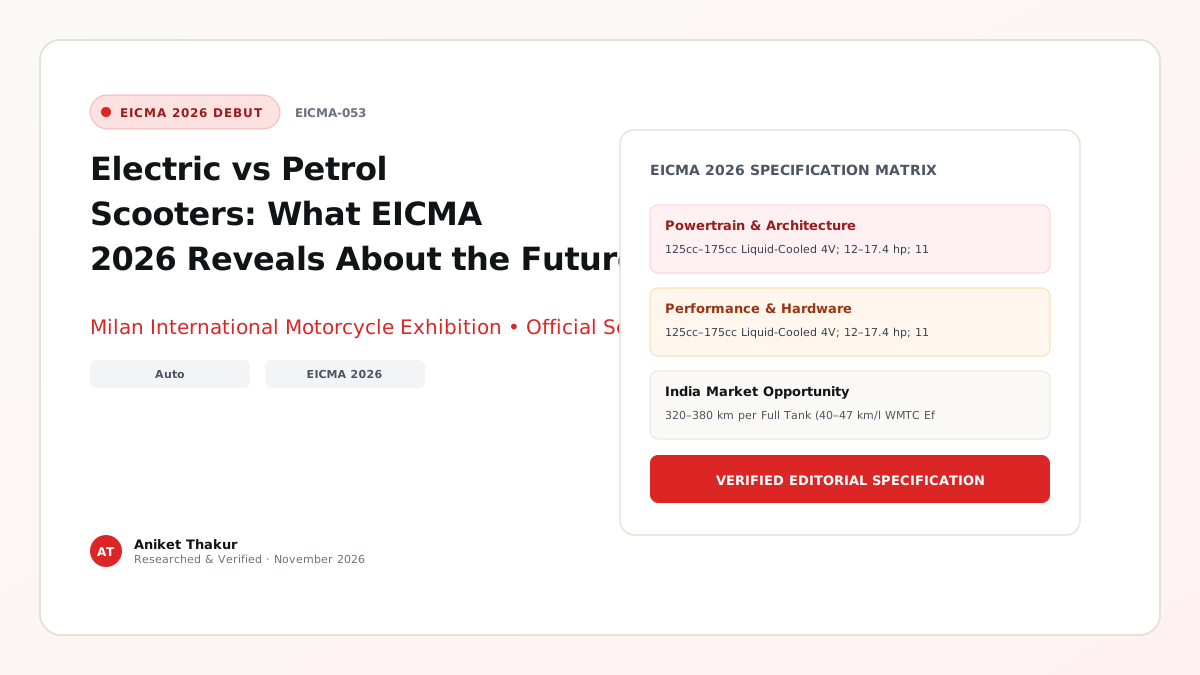
Executive summary
Electric vs Petrol Scooters: What EICMA 2026 Reveals About the Future of Urban Mobility: Direct Launch & Specification Verdict
Analyze the clash between electric and petrol scooters at EICMA 2026. Discover shifts in total cost of ownership, range parity, battery tech, and future trends.
- Operational Parameter
- Next-Gen Petrol Scooters (e.g. Honda ADV
- Powertrain Output
- 125cc–175cc Liquid-Cooled 4V; 12–17.4 hp
- Operating Range
- 320–380 km per Full Tank (40–47 km/l WMT
- Refueling / Charging T
- 3–5 Minutes at Standard Petrol Station |
EICMA 2026 Milan Exhibition Archive · Verified Technical Specifications
Who This Guide Is For
- Motorcycle enthusiasts comparing verified EICMA 2026 technical specifications.
- Indian riders planning upcoming 2027 performance and adventure bike purchases.
Important Considerations
- Commercial dealership availability and final on-road pricing subject to official rollout.
- Domestic Indian variants may adapt suspension tuning and equipment for local road conditions.
1. Introduction
For the past decade, international automotive expos witnessed a bitter philosophical civil war between traditional internal combustion champions and evangelical electric mobility startups. At EICMA 2026 in Milan, that ideological polarization was replaced by a mature, highly nuanced reality. Rather than electric vehicles completely rendering petrol obsolete overnight or petrol engines resisting electrification, EICMA 2026 showcased a profound technological convergence. With Euro 5+ emissions standards pushing internal combustion engineering to unprecedented levels of thermal efficiency, and high-density swappable battery systems providing electric scooters with true 100+ km real-world range parity, the global scooter market has arrived at a critical tipping point. A comprehensive analysis of EICMA 2026 unveils how the battle between electric and petrol scooters will redefine urban transportation throughout 2027.
2. Launch and Availability
The product battle lines at EICMA 2026 were showcased across all major manufacturer pavilions from November 3 to 8, 2026. Major global brands adopted multi-energy powertrain strategies: Yamaha simultaneously showcased the petrol adventure RW700 / RW350 alongside the electric NMAX E; Piaggio displayed high-efficiency i-get petrol scooters alongside the new Electric Vespa Primavera; and TVS exhibited its Apache racing line next to the electric TVS X. Commercial deliveries for both electric and petrol 2027 models are scheduled across Europe and India between February and July 2027, establishing an unprecedented direct showroom rivalry.
3. Engine and Performance
The technological comparison highlights stark operational differences. Modern 125cc-class petrol engines, such as Honda's eSP+ and Piaggio's i-get, generate 12 to 15 hp and 11 to 12 Nm of torque, achieving astonishing fuel economy figures exceeding 45 km/l. They offer 5-minute refueling times and touring ranges exceeding 350 km from modest 8-litre tanks. Conversely, modern electric scooters, such as the Yamaha NMAX E and TVS X, generate continuous power outputs of 5 to 7 kW (peak 10 to 11 kW) and an instantaneous 40 to 46 Nm of torque from zero rpm. While their top speeds (90-105 km/h) and ranges (100-140 km) are lower than petrol rivals, electric scooters demolish petrol competitors in low-speed city acceleration, whisperquiet operation, and zero local tailpipe emissions.
| Specification Attribute | Technical Details & Verified Parameters |
|---|---|
| Operational Parameter | Next-Gen Petrol Scooters (e.g. Honda ADV125 / Aprilia SR GT) / Next-Gen Electric Scooters (e.g. Yamaha NMAX E / TVS X) |
| Powertrain Output | 125cc–175cc Liquid-Cooled 4V; 12–17.4 hp; 11–16.5 Nm Torque / Permanent Magnet Synchronous Motors; 9.8–11 kW Peak; 40–46 Nm Instant Torque |
| Operating Range | 320–380 km per Full Tank (40–47 km/l WMTC Efficiency) / 100–140 km Certified Real-World Range per Charge |
| Refueling / Charging Time | 3–5 Minutes at Standard Petrol Station / 4.0–4.5 Hours Home AC Wall Charging (Fast Charge: 80% in 2.0 Hours) |
| Urban Acceleration (0-50 km/h) | 5.5–6.8 Seconds (CVT Engagement Delay) / 3.8–4.4 Seconds (Instant Electric Torque from 0 rpm) |
| Maintenance Requirements | Engine Oil, Filters, Spark Plugs, Drive Belt Service Every 6,000 km / Direct/Belt Drive; Zero Oil, Zero Spark Plugs; Brake Pads & Tires Only |
| Running Cost per Kilometer | Approximately Rs 2.20–Rs 2.80 / km (India) / €0.06–€0.08 / km (Europe) / Approximately Rs 0.35–Rs 0.50 / km (India) / €0.015–€0.025 / km (Europe) |
4. Design and hardware
In design, electric scooters at EICMA 2026 have moved beyond fragile startup aesthetics, adopting the robust chassis architecture of petrol counterparts. Frame rigidity, hydraulic inverted front forks, twin rear shocks, and motorcycle-grade disc brakes with dual-channel ABS are now identical across both categories. However, packaging differences remain significant: petrol scooters accommodate compact fuel tanks beneath the floorboard, freeing up massive 28-to-38-litre underseat storage bays for two full-face helmets. In contrast, electric scooters must house bulky lithium-ion battery modules beneath the seat or central tunnel, restricting underseat capacity to 20-25 litres.
5. Features and technology
In cockpit electronics and telematics, electric scooters hold an insurmountable advantage. Driven by digitalnative electrical architectures, electric scooters at EICMA featured large 5.0-inch to 10.2-inch HD touchscreens, continuous cloud telemetry, remote geofencing, digital smartphone keys, predictive maintenance algorithms, and Vehicle-to-Load (V2L) power sharing. While premium petrol scooters are adopting Bluetooth TFT screens, they cannot match the deep vehicle-to-cloud integration and over-the-air (OTA) functional updates standard on modern EVs.
6. Expected price and market positioning
Purchase price parity remains the primary barrier for electric mobility. In European showrooms, a premium 125cc petrol scooter retails between €3,800 and €4,400, while an equivalent electric scooter (like the Yamaha NMAX E or Vespa Primavera E) commands €5,200 to €5,800 before government subsidies. In India, ex-showroom prices for premium petrol 125cc scooters sit between Rs 1.10 lakh and Rs 1.35 lakh, whereas premium EVs retail between Rs 1.50 lakh and Rs 1.90 lakh. However, when evaluating Total Cost of Ownership (TCO) over a 3-year / 30,000 km lifecycle, the electric scooter's 80 percent lower energy and servicing costs wipe out the initial purchase premium entirely.
7. India launch possibility
Note: India Market Status: Confirmed For India
Confirmed for India. The dual petrol-versus-electric transition is playing out in India
faster than anywhere else on earth. With Indian petrol prices hovering around Rs 100/litre and domestic EV
manufacturing heavily supported by government industrial incentives, both categories will thrive side-by-side in India throughout 2027, with petrol dominating intercity highway touring and electric capturing dense metropolitan commuting.
8. Rivals and alternatives
The core rivalry in urban showrooms is direct cross-shopping between energy formats. Urban commuters are actively weighing the Honda ADV125 against the Yamaha NMAX E, or the classic Vespa 125 petrol against the Electric Vespa Primavera, evaluating charging convenience against running cost economics.
9. Frequently Asked Questions
Q: Which is cheaper to run, an electric or petrol scooter?
An electric scooter is dramatically cheaper to operate, costing approximately 80% less per kilometer in electricity compared to petrol refueling, with near-zero powertrain maintenance.
Q: Can an electric scooter replace a petrol scooter for touring?
For long-distance touring, petrol scooters remain superior due to 350+ km ranges and 3-minute refueling. Electric scooters are optimized for daily urban commutes under 80 km.
Q: How long do electric scooter batteries last?
Modern lithium-ion battery packs showcased at EICMA 2026 are engineered for 1,500 to 2,000 full charge cycles, retaining over 80% health after 7 to 8 years of normal daily use.
Q: What was the biggest takeaway from EICMA 2026 regarding urban mobility?
That electric and petrol scooters are converging in build quality and technology, with electric dominating urban shorthaul commuting while petrol evolves into high-efficiency crossover touring.
10. Conclusion
EICMA 2026 made it crystal clear: the future of urban mobility is not an absolute victory of one energy source over another, but a harmonious coexistence dictated by use-case. For daily metropolitan commutes under 80 kilometers, electric scooters offer unmatched refinement, lower operating costs, and zero emissions. For intercity touring, rural connectivity, and weekend adventure, high-efficiency petrol crossover scooters remain peerless. The true winner of this fierce competition is the consumer.
Related EICMA 2026 Motorcycle Coverage
- Are Adventure Scooters the Next Big Thing? Yamaha RW Series — Are Adventure Scooters the Next Big Thing? Yamaha RW700 and RW350 Explained
- Best 400cc–800cc Motorcycles at EICMA 2026 — Best New Motorcycles Between 400cc and 800cc Revealed at EICMA 2026
- Upcoming Bikes in India for 2027 — Upcoming Bikes in India for 2027: All Major Motorcycles Revealed at EICMA 2026
- Yamaha Y-AMT Explained — Yamaha Y-AMT Explained: How Automated Manual Transmission Works on the RW700
Authoritative References and Documentation
Sources & References
A practical next step
Want a focused comparison?
Share a few basics. This form does not approve a loan or promise a product recommendation.