Indian Motorcycle Industry vs European Motorcycle Brands: Key EICMA 2026 Developments
Analyze the seismic clash between Indian manufacturers and European legacy brands at EICMA 2026, highlighting pricing, engineering, and market shifts.

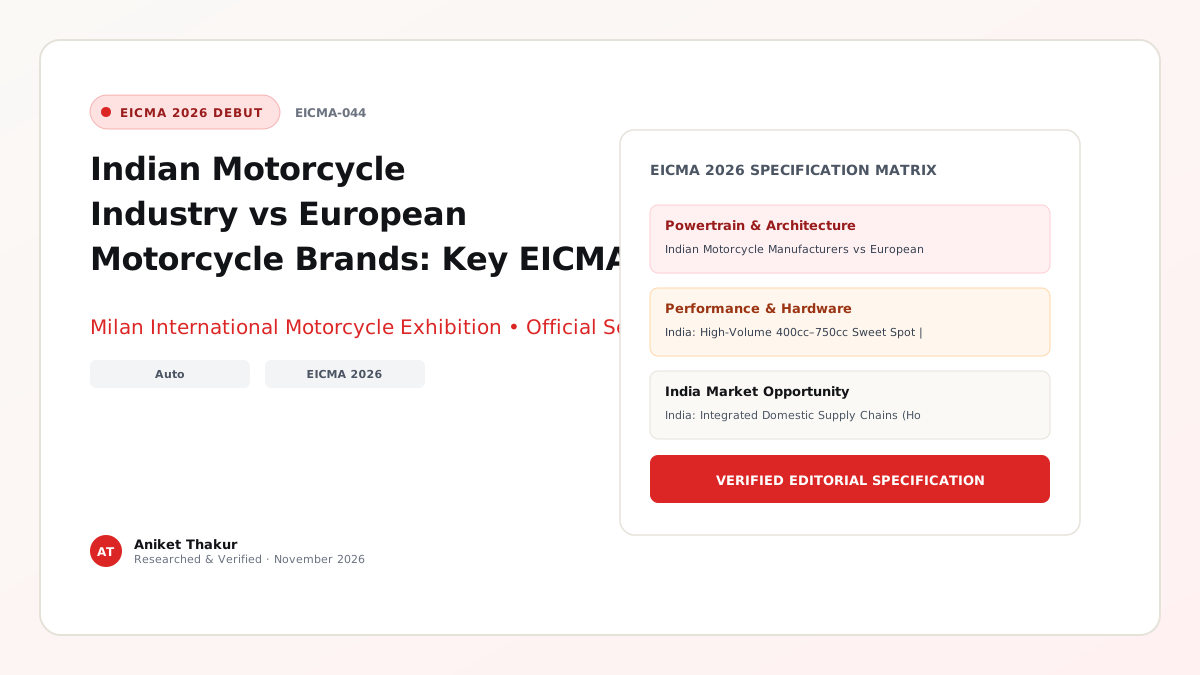
Executive summary
Indian Motorcycle Industry vs European Motorcycle Brands: Key EICMA 2026 Developments: Direct Launch & Specification Verdict
Analyze the seismic clash between Indian manufacturers and European legacy brands at EICMA 2026, highlighting pricing, engineering, and market shifts.
- Strategic Domain
- Indian Motorcycle Manufacturers vs Europ
- Target Market Focus
- India: High-Volume 400cc–750cc Sweet Spo
- Manufacturing Economic
- India: Integrated Domestic Supply Chains
- R&D Strategy
- India: Hybrid Indo-European Centers (Mun
EICMA 2026 Milan Exhibition Archive · Verified Technical Specifications
Who This Guide Is For
- Motorcycle enthusiasts comparing verified EICMA 2026 technical specifications.
- Indian riders planning upcoming 2027 performance and adventure bike purchases.
Important Considerations
- Commercial dealership availability and final on-road pricing subject to official rollout.
- Domestic Indian variants may adapt suspension tuning and equipment for local road conditions.
1. Introduction
The historic halls of Fiera Milano at EICMA 2026 witnessed a profound structural realignment of global motorcycle power. For over a century, European brands like BMW Motorrad, Ducati, KTM, Triumph, and Piaggio dictated the styling, technological, and performance benchmarks of the international motorcycle industry, while Indian manufacturers operated in the background as high-volume contract assemblers or lowdisplacement domestic suppliers. However, EICMA 2026 demonstrated that this traditional dynamic has evaporated. Today, Indian powerhouses—Hero MotoCorp, TVS Motor Company, and Royal Enfield—are directly confronting European legacy brands on their home soil. Armed with immense capital reserves, worldclass Indo-European R&D centers, Dakar rally racing pedigree, and an insurmountable manufacturing cost advantage, the Indian motorcycle industry has launched an aggressive assault on Europe's most lucrative volume stronghold: the 400cc to 750cc middleweight category.
2. Launch and Availability
The competitive clash between Indian and European manufacturers was laid bare during the product rollouts at EICMA on November 3, 2026. While European manufacturers focused heavily on ultra-expensive, lowvolume halo superbikes exceeding €25,000 (such as the Ducati Panigale V4 SP and Aprilia RSV4 Obscure Spe.Ed.), Indian manufacturers targeted the heart of the global motorcycle buying public with accessible, production-ready 400cc to 750cc machines scheduled for commercial delivery across Europe in early-to-mid 2027. Furthermore, Indian brands showcased mature international retail infrastructure, moving away from third-party importers toward wholly owned European subsidiaries and exclusive brand experience galleries.
3. Engine and Performance
The technological battlefield at EICMA 2026 centered on the global A2-licence 35 kW to 70 kW power spectrum. European manufacturers have increasingly struggled with escalating European labor and energy costs, forcing many to downsize development or rely on Asian manufacturing alliances. In contrast, Indian manufacturers displayed cutting-edge in-house powertrains: Hero's Dakar-honed 421cc single (46 bhp), TVS-Norton's 454cc single (47 bhp), and Royal Enfield's clean-sheet 750cc liquid-cooled twin (58-62 bhp). These engines matched European competitors in specific power, thermal efficiency, and Euro 5+ emissions compliance, while delivering superior low-end torque profiles optimized for real-world riding.
| Specification Attribute | Technical Details & Verified Parameters |
|---|---|
| Strategic Domain | Indian Motorcycle Manufacturers vs European Motorcycle Brands |
| Target Market Focus | India: High-Volume 400cc–750cc Sweet Spot / Europe: High-Margin €20,000+ Halo Superbikes |
| Manufacturing Economics | India: Integrated Domestic Supply Chains (Hosur, Chennai, Neemrana) / Europe: High Labor & Energy Overhead |
| R&D Strategy | India: Hybrid Indo-European Centers (Munich, UK, India) / Europe: Traditional Headquarters R&D |
| Price-to-Spec Ratio | India: Inverted Forks, Full TFT, IMU at €6,000–€8,500 / Europe: Premium Components Reserved for €12,000+ |
| Electric Strategy | India: Accessible Urban Commuters & Scramblers (Vida, Flying Flea) / Europe: Niche Hyper-EVs (BMW CE 02) |
| Global Market Trend | Indian Conglomerates Owning & Revitalizing European Marques (TVS Norton, Bajaj KTM/Triumph) |
4. Design and hardware
A significant shift observed at EICMA 2026 was the closing of the design and hardware gap. Historically, European brands commanded an unassailable advantage in visual sophistication, surface finishing, and suspension engineering. At EICMA 2026, Indian motorcycles shattered this stereotype. The Royal Enfield Himalayan 750 showcased Harris Performance chassis engineering, Showa suspension, and tubeless spoked wheels that rivaled the Yamaha Ténéré 700 and BMW F 800 GS. The TVS-developed Norton 450 Urban exhibited flawless British minimalism with tight panel tolerances, while Hero's XPulse 450 incorporated genuine Dakar rally navigation ergonomics. Indian manufacturers are no longer copying European design— they are setting contemporary aesthetic trends.
5. Features and technology
Technology democratization was another decisive battleground. European legacy brands have traditionally reserved advanced electronic rider aids—such as full-colour TFT displays, lean-sensitive Cornering ABS, and bi-directional quickshifters—for high-end premium models, leaving middleweights with basic LCD gauges and spartan electronics. Indian manufacturers disrupted this hierarchy by standardizing premium technology on sub-€8,000 motorcycles: Hero introduced wireless Apple CarPlay and Android Auto on the XPulse 450, TVS offered IMU-backed traction control on the Norton and Apache lines, and Royal Enfield equipped its 750 twins with Google Maps-powered TripperDash navigation.
6. Expected price and market positioning
The defining advantage of the Indian motorcycle industry is its structural cost efficiency. By managing the entire manufacturing lifecycle—from foundries and robotic frame welding to engine machining—within massive, highly automated Indian industrial complexes, Indian manufacturers can price equivalent middleweight motorcycles 25 to 35 percent below European competitors. In European showrooms, where young riders face escalating inflation and insurance costs, an authentic 46 bhp adventure bike like the XPulse 450 at €6,200 or a 58 bhp twin like the Himalayan 750 at €8,500 provides an irresistible value proposition that European factories cannot match.
7. India launch possibility
Note: India Market Status: Confirmed For India
Confirmed for India. The global escalation of Indian manufacturers has profound
domestic benefits. Every engine, chassis, and technology suite unveiled at EICMA 2026 will be available to Indian riders throughout 2027 at domestic ex-showroom prices free of import duties. This will accelerate the transformation of India's domestic motorcycle culture from basic utility commuting to world-class adventure touring, sport riding, and lifestyle motorcycling.
8. Rivals and alternatives
The ongoing struggle at EICMA 2026 directly pits Indian manufacturers against European titans: Hero vs KTM and Aprilia; TVS-Norton vs Triumph and BMW Motorrad; and Royal Enfield vs Moto Guzzi and Yamaha. The emerging reality is that European manufacturers are increasingly ceding the middleweight volume market to Indian brands, choosing to retreat into high-margin luxury niches.
9. Frequently Asked Questions
Q: How are Indian manufacturers disrupting European motorcycle brands?
By delivering high-quality 400cc-750cc middleweight motorcycles with premium technology (TFT, IMU, quickshifters) at prices 25-35% lower than European rivals.
Q: Why can't European brands match Indian pricing?
European manufacturers face significantly higher labor costs, rigid energy overheads, and smaller domestic production volumes compared to Indian manufacturing giants.
Q: Are Indian motorcycles built with European quality?
Yes, Indian manufacturers utilize hybrid Indo-European R&D teams and world-class automated domestic factories that meet strict Euro 5+ quality standards.
Q: Which segment are Indian brands dominating globally?
Indian brands are dominating the global A2-licence 400cc to 750cc middleweight adventure, modern-classic, and roadster categories.
10. Conclusion
The developments at EICMA 2026 confirm that the global motorcycle industry has entered a new multipolar era. Indian motorcycle manufacturers are no longer peripheral players; through massive capital investments, cutting-edge engineering, and unbeatable manufacturing efficiency, they are out-innovating and out-pricing European legacy marques in the high-volume middleweight segments. The future of global motorcycling is being forged in India.
Related EICMA 2026 Motorcycle Coverage
- Royal Enfield Shotgun 650 Son of a Gun Unveiled — Royal Enfield Shotgun 650 Son of a Gun: Limited Edition Motorcycle Explained
- Royal Enfield Himalayan 750 vs Continental GT 750 Compared — Royal Enfield Himalayan 750 vs Continental GT 750: Engine, Purpose and Key Differences
- Upcoming Bikes in India for 2027 — Upcoming Bikes in India for 2027: All Major Motorcycles Revealed at EICMA 2026
- EICMA 2026 Complete Highlights — EICMA 2026 Complete Highlights: All Major Motorcycle and Scooter Reveals
Authoritative References and Documentation
Frequently asked questions
Why can't European brands match Indian pricing?
European manufacturers face significantly higher labor costs, rigid energy overheads, and smaller domestic production volumes compared to Indian manufacturing giants.
Sources & References
A practical next step
Want a focused comparison?
Share a few basics. This form does not approve a loan or promise a product recommendation.