The Future of Motorcycle Engines: New Engine Technologies Revealed at EICMA 2026
Explore the revolutionary internal combustion engine technologies revealed at EICMA 2026: electric superchargers, variable valve timing, and Euro 5+ tech.

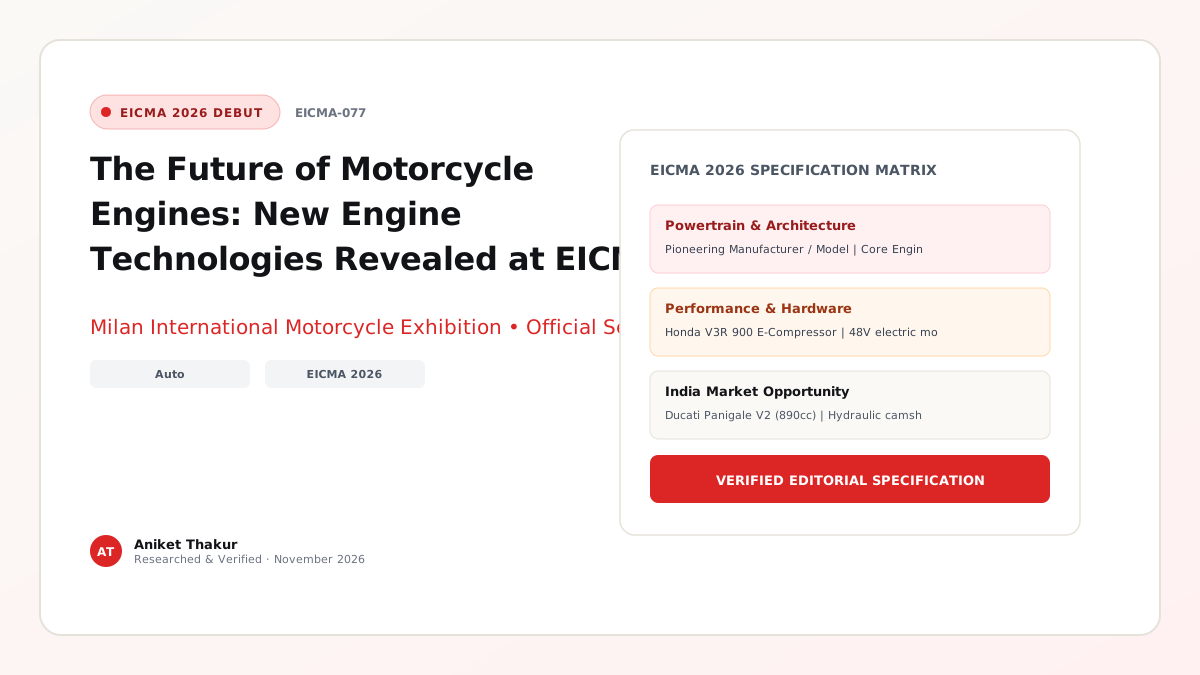
Executive summary
The Future of Motorcycle Engines: New Engine Technologies Revealed at EICMA 2026: Direct Launch & Specification Verdict
Explore the revolutionary internal combustion engine technologies revealed at EICMA 2026: electric superchargers, variable valve timing, and Euro 5+ tech.
- Engine Innovation
- Pioneering Manufacturer / Model | Core E
- Electric Centrifugal C
- Honda V3R 900 E-Compressor | 48V electri
- IVVT Intake Variable V
- Ducati Panigale V2 (890cc) | Hydraulic c
- Two-Stage Variable Air
- Honda CBR1000RR-R Fireblade SP | Electri
EICMA 2026 Milan Exhibition Archive · Verified Technical Specifications
Who This Guide Is For
- Motorcycle enthusiasts comparing verified EICMA 2026 technical specifications.
- Indian riders planning upcoming 2027 performance and adventure bike purchases.
Important Considerations
- Commercial dealership availability and final on-road pricing subject to official rollout.
- Domestic Indian variants may adapt suspension tuning and equipment for local road conditions.
1. Introduction
For the past five years, premature obituaries were written for the internal combustion engine. Pundits and regulatory bodies boldly predicted that strict Euro 5+ emissions mandates and urban decarbonization pledges would render the petrol motorcycle engine obsolete by the late 2020s. However, EICMA 2026 in Milan delivered a resounding, intellectually thrilling rebuttal. Rather than retreating into stagnation, internal combustion engine (ICE) development has entered its most creative and technically brilliant era in history. Facing uncompromising thermal, acoustic, and chemical emission limits, global motorcycle manufacturers arrived at EICMA 2026 with clean-sheet powertrain architectures: electronically driven forced induction, nondesmodromic ultra-lightweight V-twins, electronic variable air funnels, and low-friction multi-valve singles, demonstrating that internal combustion performance has extraordinary life ahead.
2. Launch and Availability
The next-generation engine platforms detailed in this report were officially showcased between November 3 and 8, 2026, at Fiera Milano. All featured engines are either entering series commercial production for the 2027 model year or completing final durability validation for 2028 commercial releases across Europe, Japan, North America, and India.
3. Engine and Performance
The undisputed technological crown of EICMA 2026 was Honda's near-production V3R 900 E-Compressor engine. By combining a 75-degree V3 four-stroke with an independent 48-volt electric supercharger capable of spinning past 100,000 rpm, Honda decoupled boost pressure from engine rpm, generating over 150 hp and flat, crushing torque from 1,500 rpm while slashing fuel consumption and emissions. Ducati shocked purists by debuting a 54.4 kg, 890cc V2 engine that replaces traditional desmo valves with conventional springs and IVVT (Intake Variable Valve Timing), proving that spring valvetrains can achieve 120 hp with lighter weight and lower friction. Meanwhile, Royal Enfield demonstrated the power of liquid cooling on its clean-sheet 750cc parallel-twin (58-62 bhp), delivering clean Euro 5+ combustion without losing its rumbling 270-degree crossplane soul.
| Specification Attribute | Technical Details & Verified Parameters |
|---|---|
| Engine Innovation | Pioneering Manufacturer / Model / Core Engineering Architecture |
| Electric Centrifugal Compressor | Honda V3R 900 E-Compressor / 48V electric motor spins intake compressor to 100k RPM |
| IVVT Intake Variable Valve Timing | Ducati Panigale V2 (890cc) / Hydraulic camshaft phaser dynamically alters valve overlap |
| Two-Stage Variable Air Funnels | Honda CBR1000RR-R Fireblade SP / Electrically actuated intake trumpet height adjustment |
| Extended Low-Speed Deactivation | Ducati Diavel V4 2027 / Shuts off rear cylinder bank below 4,000 rpm & idle |
| High-Efficiency Clean-Sheet 750 | Royal Enfield Himalayan / GT 750 / Liquid-cooled DOHC 4V per cylinder with |
| Twin | 270° crank |
| Dakar-Derived High-Tumble Single | Hero XPulse 450 (421cc) / Compact DOHC 4-valve combustion chamber with high tumble |
4. Design and hardware
Internal combustion engines at EICMA 2026 exhibited unprecedented physical compactness. By utilizing advanced finite element analysis (FEA) and high-pressure die-casting, wall thicknesses were minimized while structural rigidity increased. The Honda V3 layout creates an engine narrower than a conventional inline-four or parallel-twin, enabling aerodynamic chassis packaging. In cooling design, split-circuit cooling systems route chilled coolant to high-heat cylinder heads first, while integrated internal oil-to-water heat exchangers eliminate fragile external oil lines, ensuring thermal equilibrium under grueling desert conditions.
5. Features and technology
Combustion chamber technology has achieved microscopic precision. Multi-point dual-spray electronic fuel injectors atomize fuel droplets down to 50 microns, pairing with high-energy twin-spark ignition systems that ensure complete flame propagation even at lean air-fuel ratios. Electronic dual-motor throttle-by-wire systems manage cylinder banks independently, allowing seamless cylinder deactivation and precise engine braking control that prevents rear-wheel lockup without harsh slipper-clutch friction.
6. Expected price and market positioning
These engine technologies ensure that internal combustion motorcycles remain economically competitive against battery-electric vehicles. While EVs require costly raw materials for massive battery packs, highefficiency ICE engines can be manufactured at scale using established global supply chains. Manufacturers project that Euro 5+ compliant middleweight engines will power over 80 percent of global motorcycle sales through 2035, serving as the economic engine that funds long-term EV development.
7. India launch possibility
Note: India Market Status: Confirmed For India
Confirmed for India. Advanced engine platforms like Hero's 421cc single and Royal
Enfield's 750cc twin are manufactured natively in India, while Honda and Ducati will deploy their updated valvetrains across Indian showroom models in 2027.
8. Rivals and alternatives
The emerging rivalry is between traditional naturally aspirated multi-cylinder engines and new forcedinduction e-compressor concepts. As Honda's e-compressor approaches production, competitors like Yamaha and Kawasaki will be forced to respond with their own forced-induction solutions.
9. Frequently Asked Questions
Q: Why did Ducati abandon desmodromic valves on the new 890cc V2 engine?
Ducati adopted conventional valve springs with IVVT variable valve timing to reduce engine weight to a record 54.4 kg, lower mechanical friction, and double valve service intervals to 30,000 km.
Q: How does an electric supercharger help emissions?
It provides dense air on demand at low engine speeds, allowing engineers to run leaner, cleaner fuel mixtures and downsize engine displacement without sacrificing horsepower.
Q: Will internal combustion motorcycle engines be banned soon?
No. Technologies revealed at EICMA 2026 prove that modern ICE engines easily satisfy Euro 5+ and BS6 Phase 2 standards, ensuring their commercial viability well beyond 2035.
Q: What is the advantage of variable air funnels?
Longer intake funnels boost low-rpm air velocity for torque, while shorter funnels maximize high-rpm airflow for peak horsepower; variable funnels dynamically provide both.
10. Conclusion
The engine technologies unveiled at EICMA 2026 prove that the internal combustion motorcycle engine is undergoing a triumphant renaissance. By embracing electric supercharging, variable intake geometry, advanced variable valve timing, and cylinder deactivation, engineers have unlocked unprecedented thresholds of power, efficiency, and emotional acoustic drama. The internal combustion engine is not dying— it is evolving into its most brilliant form.
Related EICMA 2026 Motorcycle Coverage
- Yamaha Y-AMT Explained — Yamaha Y-AMT Explained: How Automated Manual Transmission Works on the RW700
- BMW F 450 RR vs Suzuki GSX-10R — BMW F 450 RR vs Suzuki GSX-10R: Two Different Approaches to Sportbike Performance
- Upcoming Bikes in India for 2027 — Upcoming Bikes in India for 2027: All Major Motorcycles Revealed at EICMA 2026
- EICMA 2026 vs EICMA 2025 — EICMA 2026 vs EICMA 2025: Biggest Changes in Motorcycle Design and Technology
Authoritative References and Documentation
Sources & References
A practical next step
Want a focused comparison?
Share a few basics. This form does not approve a loan or promise a product recommendation.