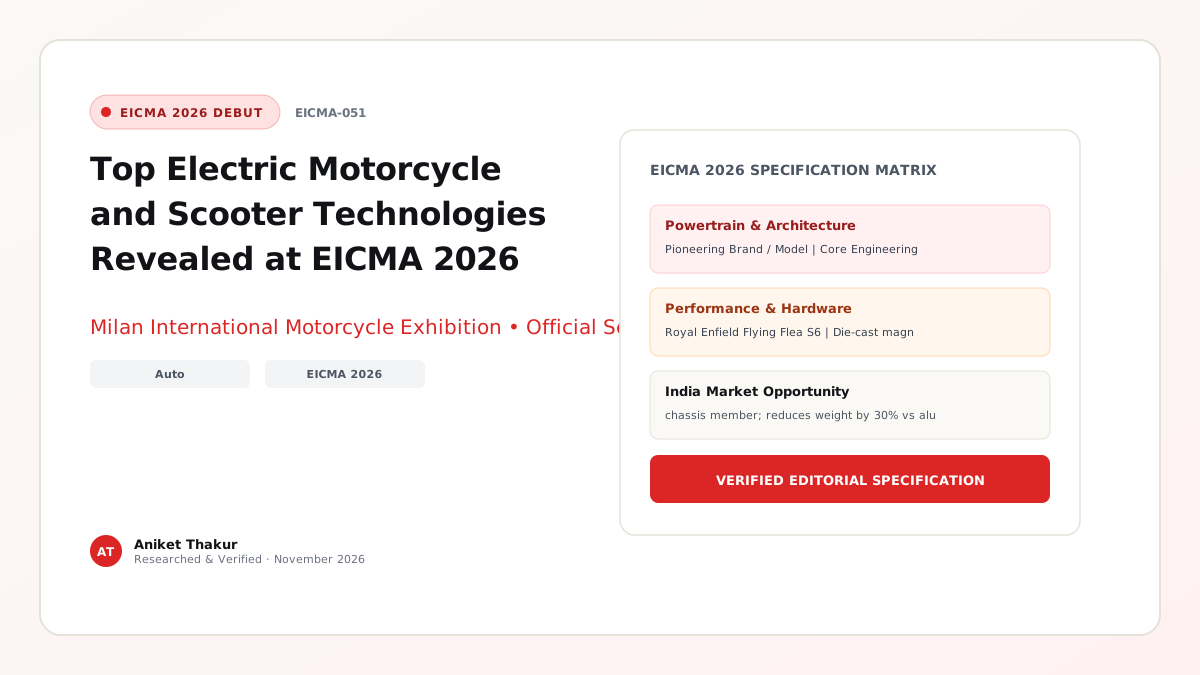
Top Electric Motorcycle and Scooter Technologies Revealed at EICMA 2026
Explore the breakthrough EV motorcycle and scooter technologies revealed at EICMA 2026: magnesium battery casings, swappable dual packs, and V2L power.

Executive summary
Top Electric Motorcycle and Scooter Technologies Revealed at EICMA 2026: Direct Launch & Specification Verdict
Explore the breakthrough EV motorcycle and scooter technologies revealed at EICMA 2026: magnesium battery casings, swappable dual packs, and V2L power.
- Breakthrough Technolog
- Pioneering Brand / Model | Core Engineer
- Structural Magnesium B
- Royal Enfield Flying Flea S6 | Die-cast
- Enclosure
- chassis member; reduces weight by 30% vs
- Dual Swappable 50.4V B
- Yamaha NMAX E & XENTER E | Two 11.5 kg p
EICMA 2026 Milan Exhibition Archive · Verified Technical Specifications
Who This Guide Is For
- Motorcycle enthusiasts comparing verified EICMA 2026 technical specifications.
- Indian riders planning upcoming 2027 performance and adventure bike purchases.
Important Considerations
- Commercial dealership availability and final on-road pricing subject to official rollout.
- Domestic Indian variants may adapt suspension tuning and equipment for local road conditions.
1. Introduction
The 83rd edition of EICMA in Milan witnessed a profound technological watershed in electric two-wheeler engineering. In past years, electric motorcycle displays were largely characterized by cobbled-together thirdparty components, excessive battery mass, and speculative performance claims. At EICMA 2026, the global motorcycle industry demonstrated that electric powertrain engineering has achieved true industrial maturity. Led by major global manufacturers including Royal Enfield, Yamaha, TVS Motor Company, and Piaggio, the showcases revealed radical breakthroughs across four critical technological frontiers: structural battery integration, standardized swappable modular energy packs, high-discharge regenerative braking algorithms, and advanced Vehicle-to-Load (V2L) bidirectional energy distribution.
2. Launch and Availability
These technological innovations were unveiled across global OEM exhibits from November 3 to 8, 2026, at Fiera Milano. Unlike laboratory concept experiments, every core technology presented was tied directly to production-ready motorcycles scheduled for commercial showroom arrival between spring and autumn 2027. Manufacturers confirmed that the new battery and motor architectures comply fully with strict UN ECE R136 international electric motorcycle safety and crashworthiness regulations.
3. Engine and Performance
The primary propulsion breakthrough at EICMA 2026 was the widespread adoption of liquid-cooled and oilcooled Interior Permanent Magnet Synchronous Motors (IPMSM) integrated directly into swingarm pivots or central chassis cradles. Yamaha's NMAX E demonstrated a compact 9.8 kW mid-drive motor linked to a lownoise carbon-reinforced belt, eliminating heavy transmission reduction gearboxes. TVS highlighted an 11 kW motor capable of withstanding continuous high-speed thermal load without derating power, while Royal Enfield introduced an ultra-compact permanent magnet motor seamlessly integrated into its forged aluminum frame, generating 48 Nm of instantaneous torque while maintaining a featherweight 105 kg motorcycle kerb weight.
| Specification Attribute | Technical Details & Verified Parameters |
|---|---|
| Breakthrough Technology | Pioneering Brand / Model / Core Engineering Innovation & Real-World Impact |
| Structural Magnesium Battery | Royal Enfield Flying Flea S6 / Die-cast magnesium housing acts as a structural |
| Enclosure | chassis member; reduces weight by 30% vs aluminum |
| Dual Swappable 50.4V Battery | Yamaha NMAX E & XENTER E / Two 11.5 kg packs with unified communication |
| System | protocol; enables apartment wall charging and 100+ km range |
| Vehicle-to-Load (V2L) Power | Hero Vida V2 / Z Platform / Bi-directional inverter allows motorcycle battery to |
| Sharing | power camping equipment, laptops, and home appliances |
| Ram-Air Battery Cooling Ducts | TVS X Global Spec / Aerodynamic fairing directs high-pressure cool air across cell modules, preventing thermal throttling at 105 km/h |
| In-Hub Removable Module | Vespa Primavera E 2027 / Brushless hub motor paired with ergonomic 3.1 kWh removable pack; preserves classic steel monocoque utility |
4. Design and hardware
In chassis design, the most celebrated innovation was the transition to structural battery enclosures. On the Royal Enfield Flying Flea S6, engineers discarded the traditional heavy steel subframe, utilizing the battery's die-cast magnesium housing as the central stressed member connecting the steering head to the swingarm. Furthermore, organic cooling fins cast directly into the magnesium shell dissipate heat passively during fast charging. Yamaha and Piaggio introduced standardized dual-swappable battery trays equipped with magnetic high-amperage docking connectors that allow riders to remove 50.4V packs with a single hand motion.
5. Features and technology
Electronics on 2026 electric two-wheelers saw the rise of sophisticated Vehicle Control Units (VCU) operating dedicated automotive operating systems. TVS showcased its 10.2-inch NavPro system running on Android Open Source Project (AOSP), offering multi-window navigation, vehicle diagnostics, and gaming capability during charging. Royal Enfield debuted proprietary VCU software that samples 200,000 data points per second to optimize regenerative braking and lean-angle safety. Bidirectional Vehicle-to-Load (V2L) technology, pioneered by Hero's Vida division, allows riders to draw up to 2.2 kW of AC power from the scooter's battery to run power tools, camping equipment, or emergency home lighting.
6. Expected price and market positioning
These technological advancements are directly driving down the total cost of ownership (TCO) for electric two-wheelers. By standardizing cell formats and utilizing automated modular pack manufacturing in India and Southeast Asia, manufacturers project that battery pack replacement costs will decline by 22 percent by 2027. In international showrooms, high-tech electric commuters featuring these systems will retail between €4,500 and €6,500, offering operational cost savings of over 75 percent compared to petrol commuters.
7. India launch possibility
Note: India Market Status: Confirmed For India
Confirmed for India. Indian manufacturing hubs are at the forefront of these
technological breakthroughs. TVS, Hero, and Royal Enfield engineer and manufacture these battery enclosures, motors, and VCUs domestically in Tamil Nadu, Rajasthan, and Haryana. Every technology unveiled at EICMA 2026 will be actively deployed across domestic Indian electric motorcycle lineups throughout 2027.
8. Rivals and alternatives
These mainstream OEM technologies directly challenge early EV startups. By combining automotive-grade durability, structural magnesium engineering, and widespread dealer support, legacy brands like Yamaha, TVS, and Royal Enfield are establishing competitive barriers that small-scale electric assemblers cannot match.
9. Frequently Asked Questions
Q: What is the benefit of a magnesium battery casing?
Magnesium is 30% lighter than aluminum while offering exceptional structural rigidity and superior passive thermal dissipation for electric motorcycle batteries.
Q: How does Vehicle-to-Load (V2L) work on an electric scooter?
V2L uses a bi-directional onboard inverter that allows the scooter's main traction battery to power external AC appliances such as laptops, lighting, and power tools.
Q: Are swappable batteries becoming an industry standard?
Yes, major brands like Yamaha, Piaggio, and Honda are converging toward modular 48V-50.4V swappable battery formats to eliminate charging downtime.
Q: When will these EV technologies appear in production bikes?
Every technology featured at EICMA 2026 is scheduled for consumer delivery in production motorcycles between early and late 2027.
10. Conclusion
The technological marvels unveiled at EICMA 2026 mark the definitive arrival of the second-generation electric motorcycle. By overcoming previous compromises with structural magnesium architecture, swappable energy standards, bidirectional V2L power, and intelligent VCU software, global manufacturers have proved that electric two-wheelers can deliver unprecedented efficiency, utility, and riding emotion.
Related EICMA 2026 Motorcycle Coverage
- Royal Enfield Flying Flea S6 vs Electric Scramblers — Royal Enfield Flying Flea S6 vs Other Electric Scramblers: What Makes It Different?
- Norton 450 Urban vs Hero XPulse 450 Compared — Norton 450 Urban vs Hero XPulse 450: What Indian Buyers Should Know
- Upcoming Bikes in India for 2027 — Upcoming Bikes in India for 2027: All Major Motorcycles Revealed at EICMA 2026
- Yamaha Y-AMT Explained — Yamaha Y-AMT Explained: How Automated Manual Transmission Works on the RW700
Authoritative References and Documentation
Sources & References
A practical next step
Want a focused comparison?
Share a few basics. This form does not approve a loan or promise a product recommendation.