AI Agents: What Are They and How Do They Work?
Learn what AI agents are, how they reason, use tools, remember context and complete tasks, with practical examples, architecture and implementation guidance.

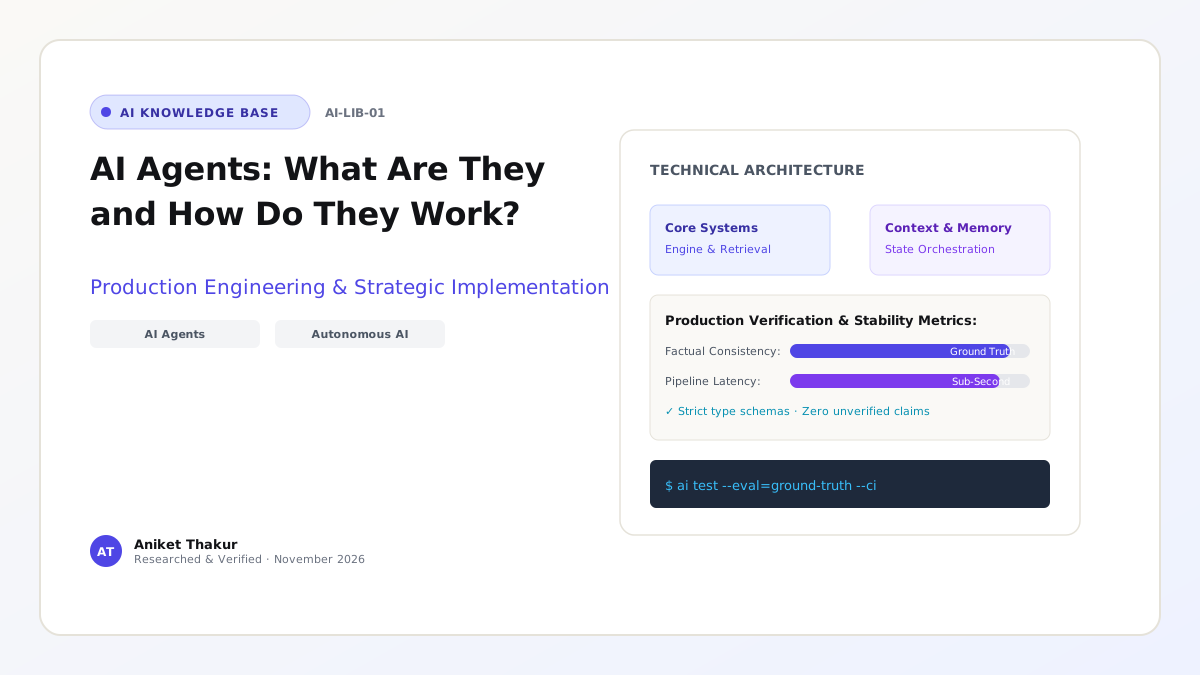
Executive summary
Overview: AI Agents: What Are They and How Do They Work?
Learn what AI agents are, how they reason, use tools, remember context and complete tasks, with practical examples, architecture and implementation guidance. This technical guide outlines architectural principles, verification requirements, production engineering trade-offs, and failure recovery protocols.
- Architecture
- Production AI & Engineering Systems
- Primary Stack
- Python 3.12 / FastAPI / Pydantic
- Series Section
- Part I: AI Agents & Autonomous Systems
- Verified As Of
- November 2026
Who This Guide Is For
- Production AI architecture requiring verifiable reliability & explicit guardrails
- Engineering teams designing resilient, cost-effective AI workflows
Important Considerations
- Enforce strict input validation to prevent prompt injection and data drift
- Maintain human-in-the-loop controls for sensitive or consequential operations
Informational / educational / practical implementation
AI Agents: What Are They and How Do They Work?
An AI agent is a software system that uses an AI model to pursue a goal by interpreting information, choosing actions and observing the results. Unlike a conventional chatbot that mainly responds to a prompt, an agent can interact with tools, retrieve data, call APIs and continue through multiple steps. The defining idea is not that the system is fully independent; it is that the system can select and execute bounded actions within rules set by its designer. This makes agents useful for workflows in which the next step depends on the current state.
How an AI agent works
A practical agent usually combines a model, instructions, context, tools and a control loop. First, the system receives a goal and relevant context. The model interprets the request and decides whether it can answer directly or needs an action. It may call a search tool, query a database, create a ticket or invoke a business API. The tool returns structured output, which becomes new context. The model then decides whether to take another step, ask the user for clarification or provide a final result. A reliable implementation places limits on the number of steps, permitted tools, execution time and data that can be accessed.
Core components
The model provides language understanding and decision support. Instructions define the agent's role, boundaries and expected output. Tools connect it to systems outside the model. State stores the current task, completed actions and relevant results. Memory may preserve selected information across sessions, but persistent memory should be explicit and governed. An orchestrator manages the workflow, retries and hand-offs. Finally, evaluation and observability help teams understand whether the agent selected the right tool, used correct arguments and reached a valid outcome.
Where agents are useful
Agents are useful when a task involves several dependent steps, changing information or multiple software systems. Examples include researching a supplier, preparing a support case, reconciling an invoice, triaging a software incident or collecting documents for a loan application. A customer-support agent might retrieve an order, check a delivery status and draft a response. A human should approve sensitive actions such as refunds, account changes or credit decisions.
How to build one
Start with one narrow workflow and define its success condition. Write down the inputs, expected outputs, allowed actions and prohibited actions. Implement deterministic functions for important operations, then expose only the functions the model needs through typed tool schemas. Keep business rules in ordinary code or policy services rather than relying on a prompt. Persist task state so that failures do not erase progress. Add authentication, authorization, timeouts, rate limits, structured logs and an audit record for each tool call. Test normal, ambiguous, malicious and failure cases before deployment.
Risks and engineering considerations
Agents can misunderstand instructions, select the wrong tool, pass invalid parameters or act on untrusted content. Retrieved documents and web pages may contain prompt injection attempts. Tool permissions should therefore follow least privilege, and external content must be treated as data rather than instructions. Validate every argument server-side. Use idempotency keys for actions that may be retried. Require human approval for irreversible or high-impact operations. Track task completion, factual accuracy, tool-call success, latency and cost rather than judging quality from fluent responses alone.
The long-term direction
Agents are likely to become more useful as models improve at planning, tool selection and multimodal interpretation. However, dependable agents will still require clear workflows, strong permissions, reliable integrations and measurable evaluation. The strongest systems will not maximize autonomy at all costs. They will automate routine work while making uncertainty, exceptions and approval requirements visible. For most organizations, a narrow agent that completes one business process safely is more valuable than a general agent with broad but poorly controlled access.
Implementation sequence: from prototype to working system
A sensible delivery sequence is to prove the smallest useful workflow before adding optional capabilities. First create a representative input set and define the expected output. Next implement the deterministic parts of the workflow and confirm their behavior without an LLM. Add the model only for the part that needs language interpretation or generation. Connect one external system at a time, write contract tests for the integration and add a visible review state. Begin with a read-only agent. Implement one tool with a strict input schema, return a compact structured result and log the request identifier. Add a second tool only after the first is reliable. Introduce task state, explicit completion criteria and a maximum number of model/tool turns. Finally, add confirmation for any operation that changes a record or communicates externally. Finish the first release with a repeatable local setup and a documented demonstration path.
Failure handling, auditability and human control
Operational controls should make failure recoverable rather than invisible. Typical failures include a model inventing an identifier, calling a tool with incomplete arguments, repeating a side effect after a timeout, or interpreting untrusted text as an instruction. Prevent these with server-side validation, idempotency keys, scoped permissions, step limits and a clear separation between tool output and trusted system instructions. Give every task a status such as queued, running, awaiting review, completed or failed. Record the reason for an escalation and provide a retry path only when the underlying error is retryable. For actions that change external records, use idempotency and an audit entry so that a network timeout cannot produce duplicate work. Users should be able to tell whether the system has completed an action or merely prepared a recommendation.
Worked example: following one task from input to outcome
Consider a concrete version of the use case: A useful starting case is an operations team that receives a request, checks several systems, and then prepares a recommended next action. The agent should collect evidence and draft the next step, but it should not silently make a consequential change. That boundary makes the workflow testable and gives the user a clear point of control. The first interaction should produce a clearly defined case or task record. The system then gathers only the evidence required for that task, checks whether the evidence is current and complete, and produces an output that can be inspected by the intended user. If a required value is missing, the workflow should pause and ask for it or route the case to an exception queue. It should not silently fill the gap with a plausible guess. This example also gives the team a repeatable demo: start with a known input, show each processing stage and finish by comparing the output with the expected result.
API contracts and component boundaries
The first interface to define is the boundary between the application and the capability described in this article. A maintainable design separates the user interface, task API, orchestrator, model adapter, tool services and application database. The orchestrator owns the state machine and step budget. Tool services own authentication and business logic. The model proposes actions, but the server decides whether an action is allowed and validates its arguments before execution. For every operation, specify the caller identity, required fields, optional fields, output schema, error codes and whether the operation is read-only or changes state. Keep secrets out of model-visible messages. Return a stable case or request ID so a user can return to the same task later. If a provider or external system changes its response format, adapt it inside the integration layer instead of spreading provider-specific assumptions throughout the application.
Information lifecycle, provenance and retention
Think of information as having a lifecycle rather than treating it as prompt text. Keep customer records, workflow status and permissions in the primary database. Pass only the minimum fields required for the current step into model context. Tool results should include stable record identifiers, timestamps and source status so the agent can distinguish current facts from stale information. Do not use a vector index as the source of truth for transactional data. At ingestion, validate file type, schema and source identity. During processing, preserve the original value and record any normalized or extracted value separately. During review, capture corrections and the person or service that made them. At completion, retain only what the product genuinely needs, according to its retention policy. When a source record changes or is deleted, define how that update reaches caches, indexes, reports and downstream systems. These details are central to trustworthy operation.
How to build a meaningful evaluation set
Build an evaluation set around the actual failure modes of this topic. Create a test set of representative goals and expected outcomes. Score correct tool selection, argument validity, evidence accuracy, task completion, unnecessary tool calls and policy compliance. Also measure p50 and p95 latency, token use, cost per completed task and the percentage of tasks escalated to a person. Include routine inputs, incomplete inputs, conflicting evidence, unusual formats and out-of-scope requests. For each case, record the expected action, not just the expected sentence. For example, a system may be correct when it refuses to proceed, asks a clarifying question or escalates to a reviewer. Score the result against the task outcome and the evidence used. Keep a baseline before changing prompts, models, retrieval settings or tools; otherwise it is difficult to know whether a change improved the system.
A staged rollout that preserves user trust
Do not move directly from a local demo to unrestricted production use. Use a single agent when one model can select among a few well-defined tools. Use a graph or workflow engine when stages, approvals and recovery points must be explicit. Add specialist agents only when responsibilities require different context, tools or permissions. More agents do not automatically mean better reasoning; they often mean more hand-offs to debug. Start with a controlled pilot, a limited user group and a narrow scope. Keep the previous manual process available while users compare results and report corrections. Review exceptions, service errors and user feedback at regular intervals. Expand the supported task set only when the current scope meets its quality and reliability thresholds. Assign an operational owner who can pause the feature, investigate a failure, roll back a release and communicate known limitations. This staged approach protects users while producing evidence for the next investment.
Frequently Asked Questions
How is an AI agent different from a chatbot?
A chatbot primarily responds to messages. An AI agent can also select tools, perform bounded actions, observe results and continue a multi-step task.
Do AI agents always need multiple agents?
No. A single agent with a small set of tools is often simpler, cheaper and easier to evaluate. Multi-agent designs are justified only when responsibilities are genuinely separable.
Can an AI agent work without an LLM?
Yes. Rule-based agents and traditional automation can act autonomously. The term AI agent covers a range of approaches, not only LLM-based systems.
Are AI agents safe for business-critical work?
They can support business-critical workflows when permissions, validation, audit logs, testing and human approval are designed into the system.
What should beginners build first?
Build a narrow agent that uses one or two read-only tools, such as searching an approved knowledge base and retrieving a record from a test API.