How to Build an AI Customer Support System
An AI customer support system helps customers find answers, understand account information and resolve routine issues. The best design does not simply.

Executive summary
Overview: How to Build an AI Customer Support System
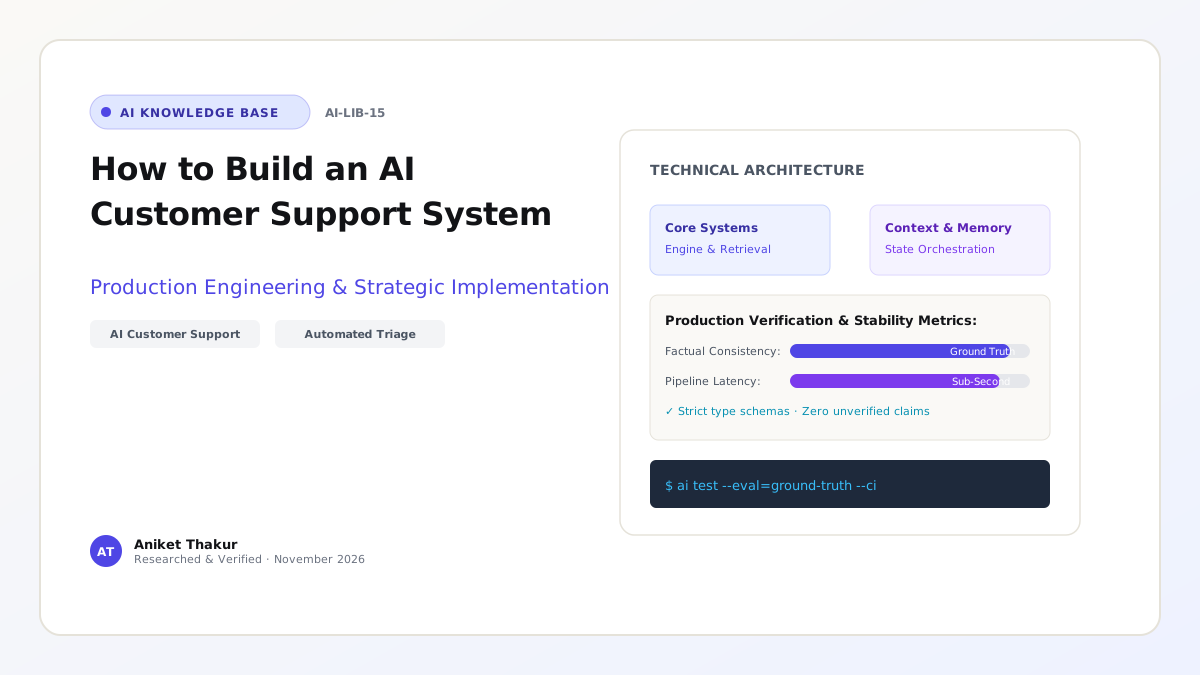
An AI customer support system helps customers find answers, understand account information and resolve routine issues. The best design does not simply. This technical guide outlines architectural principles, verification requirements, production engineering trade-offs, and failure recovery protocols.
- Architecture
- Production AI & Engineering Systems
- Primary Stack
- Python 3.12 / FastAPI / Pydantic
- Series Section
- Part III: Production Architecture & Engineering
- Verified As Of
- November 2026
Who This Guide Is For
- Production AI architecture requiring verifiable reliability & explicit guardrails
- Engineering teams designing resilient, cost-effective AI workflows
Important Considerations
- Enforce strict input validation to prevent prompt injection and data drift
- Maintain human-in-the-loop controls for sensitive or consequential operations
Informational / educational / practical implementation
How to Build an AI Customer Support System
An AI customer support system helps customers find answers, understand account information and resolve routine issues. The best design does not simply generate plausible replies. It retrieves approved policy, identifies the customer's intent, checks relevant account data and follows controlled workflows. It should also recognize when a case needs a human, especially when the issue is sensitive, unusual or high impact.
Core concepts
Map common contact reasons and separate informational questions from account-specific actions. A system may use a knowledge retrieval component for policy questions, read-only APIs for order or account status and a workflow service for actions. Keep authorization and business rules outside the model. Use a shared case record so that a human agent can see what happened.
Architecture and implementation
Begin with a limited set of high-volume intents. Create an approved knowledge base with ownership and review dates. Build retrieval with citations, connect one read-only system and add escalation. Later introduce bounded actions such as creating a ticket, with confirmation and idempotency. Test across real examples and maintain a fallback when sources are unavailable.
Practical applications
Potential applications include order tracking, billing explanations, appointment changes, product guidance and internal agent assistance. The business case should focus on resolution quality and customer experience, not only deflection. A bot that prevents customers from reaching a person can damage trust even if it reduces ticket volume.
Risks and quality controls
Risks include exposing another customer's information, inventing policy, mishandling complaints and performing unauthorized account actions. Enforce identity checks, tenant isolation, least privilege and audit logs. Provide clear escalation triggers and do not let the model invent refund, eligibility or legal commitments.
Future considerations
The future of support AI is likely to combine text, voice, workflow automation and agent-assist tools. Human teams will remain important for empathy, exceptions and judgment. Successful systems will make support faster while preserving customer control and accountability.
Implementation sequence: from prototype to working system
A sensible delivery sequence is to prove the smallest useful workflow before adding optional capabilities. First create a representative input set and define the expected output. Next implement the deterministic parts of the workflow and confirm their behavior without an LLM. Add the model only for the part that needs language interpretation or generation. Connect one external system at a time, write contract tests for the integration and add a visible review state. Analyze historical contact reasons and choose the highest-volume, lowest-risk intents. Create a reviewed knowledge base with content owners and review dates. Build retrieval with citations and a no-answer state. Add read-only case lookup, then a create-ticket action. Finally, pilot with staff and measure customer outcomes before exposing the assistant to a wider audience. Finish the first release with a repeatable local setup and a documented demonstration path.
Failure handling, auditability and human control
Operational controls should make failure recoverable rather than invisible. A support bot can frustrate users by insisting on a wrong answer or hiding access to a person. It may also expose another customer's account details or invent policy. Add explicit escalation triggers, identity checks, source citations and a visible path to human assistance. Review complaint and appeal cases carefully. Give every task a status such as queued, running, awaiting review, completed or failed. Record the reason for an escalation and provide a retry path only when the underlying error is retryable. For actions that change external records, use idempotency and an audit entry so that a network timeout cannot produce duplicate work. Users should be able to tell whether the system has completed an action or merely prepared a recommendation.
Worked example: following one task from input to outcome
Consider a concrete version of the use case: A support operation can begin with policy questions, then extend to authenticated case lookup and limited actions. The assistant should show the source of policy answers and transfer the conversation when the issue is unusual, emotional or consequential. It should preserve a concise hand-off summary so that the customer does not need to repeat everything. The first interaction should produce a clearly defined case or task record. The system then gathers only the evidence required for that task, checks whether the evidence is current and complete, and produces an output that can be inspected by the intended user. If a required value is missing, the workflow should pause and ask for it or route the case to an exception queue. It should not silently fill the gap with a plausible guess. This example also gives the team a repeatable demo: start with a known input, show each processing stage and finish by comparing the output with the expected result.
API contracts and component boundaries
The first interface to define is the boundary between the application and the capability described in this article. Use an intent and routing layer, a policy retrieval service, authenticated account tools, a case-management integration and a human-agent console. Keep the source of truth in CRM or ticketing systems. The assistant can draft replies and suggest actions, while a workflow service controls whether an action may be executed and whether an agent must approve it. For every operation, specify the caller identity, required fields, optional fields, output schema, error codes and whether the operation is read-only or changes state. Keep secrets out of model-visible messages. Return a stable case or request ID so a user can return to the same task later. If a provider or external system changes its response format, adapt it inside the integration layer instead of spreading provider-specific assumptions throughout the application.
Information lifecycle, provenance and retention
Think of information as having a lifecycle rather than treating it as prompt text. Map customer identity to account records using the approved authentication flow. Keep conversation history, retrieved passages, case IDs and action records linked but appropriately separated. Mask payment data and personal identifiers in prompts and traces where possible. Apply tenant and role filters before any customer-specific context is retrieved. At ingestion, validate file type, schema and source identity. During processing, preserve the original value and record any normalized or extracted value separately. During review, capture corrections and the person or service that made them. At completion, retain only what the product genuinely needs, according to its retention policy. When a source record changes or is deleted, define how that update reaches caches, indexes, reports and downstream systems. These details are central to trustworthy operation.
How to build a meaningful evaluation set
Build an evaluation set around the actual failure modes of this topic. Track first-contact resolution, repeat-contact rate, hand-off success, customer satisfaction, average handling time, policy-answer accuracy and rate of inappropriate deflection. Break down results by language, contact reason and customer segment to identify uneven performance. Measure agent-assist productivity separately from fully automated resolution. Include routine inputs, incomplete inputs, conflicting evidence, unusual formats and out-of-scope requests. For each case, record the expected action, not just the expected sentence. For example, a system may be correct when it refuses to proceed, asks a clarifying question or escalates to a reviewer. Score the result against the task outcome and the evidence used. Keep a baseline before changing prompts, models, retrieval settings or tools; otherwise it is difficult to know whether a change improved the system.
A staged rollout that preserves user trust
Do not move directly from a local demo to unrestricted production use. Fully automated resolution is appropriate only for narrow and well-validated tasks. Agent-assist may provide safer early value by drafting summaries and retrieving policy while a human remains responsible. Optimize for successful customer outcomes, not the maximum number of conversations contained by the bot. Start with a controlled pilot, a limited user group and a narrow scope. Keep the previous manual process available while users compare results and report corrections. Review exceptions, service errors and user feedback at regular intervals. Expand the supported task set only when the current scope meets its quality and reliability thresholds. Assign an operational owner who can pause the feature, investigate a failure, roll back a release and communicate known limitations. This staged approach protects users while producing evidence for the next investment.
Designing a useful support hand-off
A good support assistant should know when to stop. A customer who reports fraud, a safety issue, a disputed payment or a repeated unresolved complaint should not be trapped in a generic answer loop. Define escalation triggers by intent, risk, emotional context and repeated failure. The system should prepare a concise hand-off containing the customer's stated issue, verified account facts, sources consulted, steps already attempted and the reason it could not resolve the request. Make sure the human agent can correct the summary and continue the case without asking the customer to repeat everything. Record whether the hand-off was accepted, whether the agent changed the AI summary and what outcome followed. These signals can reveal gaps in knowledge, policy wording or tool integration. Evaluate deflection and resolution together: reducing the number of human contacts is not a success if customers need to contact the business again or lose access to a person.
Frequently Asked Questions
What is the central concept?
An AI customer support system helps customers find answers, understand account information and resolve routine issues.
When should it be used?
Potential applications include order tracking, billing explanations, appointment changes, product guidance and internal agent assistance.
What is a good starting point?
Begin with a limited set of high-volume intents.
What should teams watch out for?
Risks include exposing another customer's information, inventing policy, mishandling complaints and performing unauthorized account actions.
How should success be measured?
Use representative test cases and track quality, reliability, latency, cost and user outcomes.