Bajaj Chetak Range: Real-World Distance per Charge and Battery Efficiency
What is the real-world range of Bajaj Chetak? Compare 2.9 kWh, 3.2 kWh, and 35 Series 3.5 kWh (110-125 km real range) battery efficiency and charging cost.

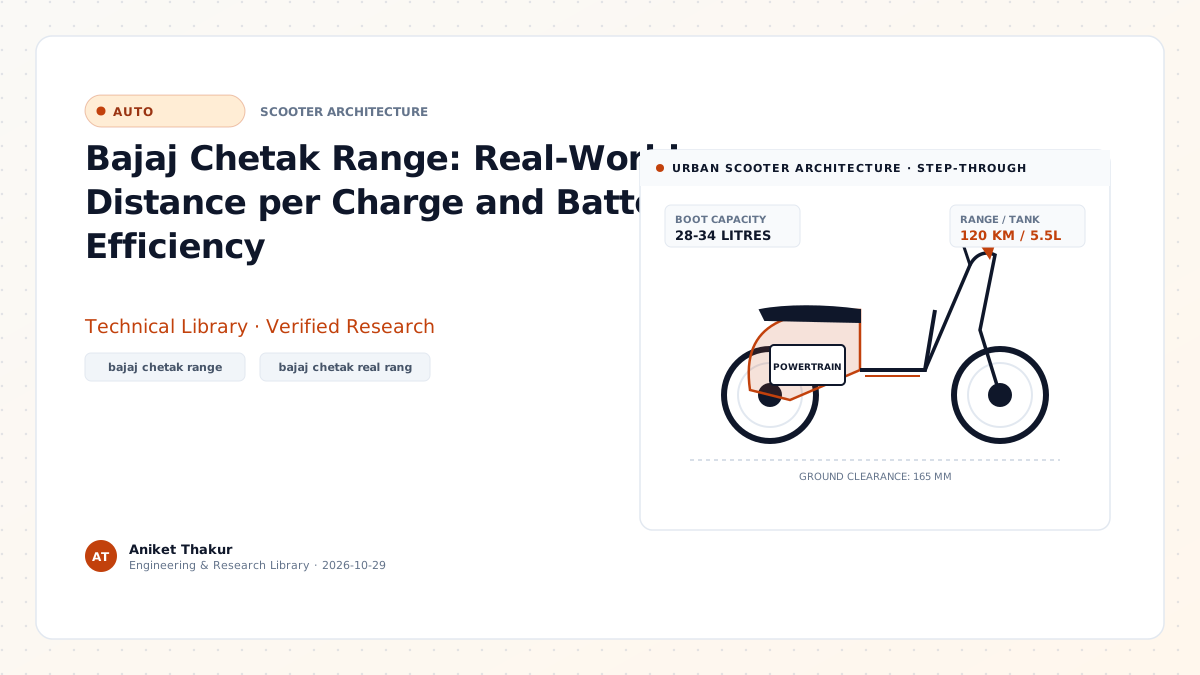
Quick Answer: The Bajaj Chetak (2.9 kWh / 3.2 kWh / 3.5 kWh (35 Series) battery) delivers a real-world city range of 90–98 km (2.9 kWh) / 100–110 km (3.2 kWh) / 110–125 km (3.5 kWh) in Eco/SmartEco mode and 75–82 km (2.9 kWh) / 85–95 km (3.2 kWh) / 95–105 km (3.5 kWh) in higher performance modes, compared to a certified claim of 123 km (2.9 kWh) / 137 km (3.2 kWh) / 153 km IDC (3.5 kWh). Accounting for ~13% AC-to-DC charging losses (3.95 kWh drawn from the wall for a 3.5 kWh pack, or 3.43 kWh/100 km), its running cost is ₹0.24/km at an illustrative ₹7.00/kWh domestic tariff (₹0.19/km in Delhi at ₹5.50/kWh). Related reading: TVS iQube vs Bajaj Chetak real range comparison. Related reading: Bajaj Chetak vs Ather Rizta range, comfort, and running cost. Related reading: Ather Rizta family electric scooter range and expenses. Related reading: petrol vs electric two-wheeler 3-year ownership cost comparison.
Certified Claimed Range vs Real-World Distance per Charge of Bajaj Chetak
When researching bajaj chetak range, buyers must never use petrol units (km/l) and must separate Indian Driving Cycle (IDC) laboratory range from real-world on-road range across riding modes, nominal battery capacity (kWh) vs wall-meter energy consumed (kWh), and electricity cost per kilometre (₹/km). Under certified laboratory testing, the Bajaj Chetak is rated at 123 km (2.9 kWh) / 137 km (3.2 kWh) / 153 km IDC (3.5 kWh). In real Indian city traffic—with rider weight, flyover gradients, and regenerative braking—riders achieve 90–98 km (2.9 kWh) / 100–110 km (3.2 kWh) / 110–125 km (3.5 kWh) in economy mode and 75–82 km (2.9 kWh) / 85–95 km (3.2 kWh) / 95–105 km (3.5 kWh) in normal/sport modes.
Available across variants (Chetak 2901 / 2903 (2.9 kWh), Chetak 3202 / 3201 (3.2 kWh), Chetak 35 Series (3501 / 3502 / 3503 with 3.5 kWh floorboard battery)), the Bajaj Chetak combines a Fixed IP67 Lithium-ion battery (under-floor on 35 Series) with a 4.0–4.2 kW PMSM swingarm-mounted motor reaching a top speed of 63 km/h (base) / 73 km/h (TecPac & 35 Series). Key highlights include Pressed steel unibody shell, IP67 water resistance, onboard charger option, and 35-litre boot on the 3.5 kWh 35 Series and 21 litres (29/32 Series) / 35 litres (35 Series floorboard battery) of under-seat storage.
Table 1: Bajaj Chetak Certified vs Real-World Range & Energy Consumption
| Range & Energy Metric | Bajaj Chetak Figure | Classification |
|---|---|---|
| Battery Capacity | 2.9 kWh / 3.2 kWh / 3.5 kWh (35 Series) | Official nominal pack capacity |
| Certified Claimed Range | 123 km (2.9 kWh) / 137 km (3.2 kWh) / 153 km IDC (3.5 kWh) | Official IDC / internal lab claim |
| Real-World Eco Range | 90–98 km (2.9 kWh) / 100–110 km (3.2 kWh) / 110–125 km (3.5 kWh) | Tested & owner city average |
| Real-World Power/Sport Range | 75–82 km (2.9 kWh) / 85–95 km (3.2 kWh) / 95–105 km (3.5 kWh) | Brisk 55–70 km/h urban speed |
| Battery vs Wall Energy | 3.04 vs 3.43 kWh/100 km | Based on 115 km & 3.95 kWh wall draw |
| Charge Time & Top Speed | 3 hr 00 min (0–80% on 3501 with 950W onboard charger) / ~4 hr 30 min (standard trims) | 63 km/h (base) / 73 km/h (TecPac & 35 Series) | Official charger & motor specs |
Battery Capacity (kWh), Charging Time and Wall-to-Battery Efficiency
A crucial distinction in EV ownership is energy stored in the battery versus energy drawn from your home electricity meter. Due to charger inverter heat and BMS cell balancing, charging a 3.5 kWh battery from 0% to 100% draws approximately 3.95 kWh from the wall socket (~13% overhead). Covering 115 km per charge equals 3.04 kWh/100 km from the battery, or 3.43 kWh/100 km at the wall plug.
Charging time for the Bajaj Chetak is 3 hr 00 min (0–80% on 3501 with 950W onboard charger) / ~4 hr 30 min (standard trims). Keeping the lithium-ion pack between 20% and 80% State of Charge (SoC) maximizes battery life, meaning a scooter with 115 km real range comfortably supports a 75 km daily round trip with a healthy reserve.
Charging Cost per Charge, per Kilometre and Monthly Electricity Expense
Using EV Charging Cost = Distance × (Wall kWh per 100 km ÷ 100) × Tariff per kWh, the matrix below shows exact running costs across verified 2026 Indian residential electricity slabs: Delhi (₹5.50/kWh), Maharashtra (₹8.50/kWh), and a ₹7.00/kWh national benchmark.
Table 2: Bajaj Chetak Home Charging Electricity Cost Matrix
| Usage Scenario | Distance | Wall Units | Delhi (@ ₹5.50/kWh) | Maharashtra (@ ₹8.50/kWh) | Baseline (@ ₹7.00/kWh) |
|---|---|---|---|---|---|
| Single Full Charge | 115 km | 3.95 kWh | ₹21.73 | ₹33.58 | ₹27.65 |
| Cost per 100 km | 100 km | 3.43 kWh | ₹18.89 | ₹29.20 | ₹24.04 |
| Monthly: 750 km | 750 km | 25.8 kWh | ₹142 | ₹219 | ₹180 |
| Monthly: 1,250 km | 1,250 km | 42.9 kWh | ₹236 | ₹365 | ₹301 |
Factors That Reduce EV Range and Conditional Buyer Verdict
Six real-world variables reduce electric scooter range by 15%–30%: riding continuously in Sport/Power mode at 63 km/h (base) / 73 km/h (TecPac & 35 Series), carrying a pillion, under-inflated tyres, steep gradients, summer heat above 40°C, and gradual cell aging after 3–5 years. Conditional Verdict: Priced at ₹99,998 – ₹1,35,000 ex-showroom, the Bajaj Chetak suits commuters covering up to 80 km/day who want ₹0.24/km energy costs. Related reading: best electric scooters for a 40 km daily commute.
Frequently Asked Questions
What is the real-world range of Bajaj Chetak in 2026?
In city riding, the Bajaj Chetak delivers 90–98 km (2.9 kWh) / 100–110 km (3.2 kWh) / 110–125 km (3.5 kWh) in Eco mode and 75–82 km (2.9 kWh) / 85–95 km (3.2 kWh) / 95–105 km (3.5 kWh) in Power/Sport modes.
What is the claimed IDC range of Bajaj Chetak?
The official claimed range of the Bajaj Chetak is 123 km (2.9 kWh) / 137 km (3.2 kWh) / 153 km IDC (3.5 kWh) depending on battery variant (2.9 kWh / 3.2 kWh / 3.5 kWh (35 Series)).
How much does it cost to fully charge Bajaj Chetak at home?
Charging the 3.5 kWh pack draws ~3.95 kWh from the wall, costing ₹21.73 in Delhi (₹5.50/kWh), ₹33.58 in Maharashtra (₹8.50/kWh), and ₹27.65 at ₹7.00/kWh.
What is the per-kilometre running cost of Bajaj Chetak?
At 115 km real range and 3.95 kWh wall draw, electricity cost is ₹0.19/km in Delhi and ₹0.24/km at ₹7.00/kWh.
How long does Bajaj Chetak take to charge?
Charging time is 3 hr 00 min (0–80% on 3501 with 950W onboard charger) / ~4 hr 30 min (standard trims).
What is the top speed and boot space of Bajaj Chetak?
The Bajaj Chetak has a top speed of 63 km/h (base) / 73 km/h (TecPac & 35 Series) and under-seat storage of 21 litres (29/32 Series) / 35 litres (35 Series floorboard battery).