How to Build a Real-Time AI Voice Assistant
Explore real-time voice assistant architecture, speech recognition, turn detection, LLMs, text-to-speech, streaming, latency, privacy and evaluation.

Executive summary
Overview: How to Build a Real-Time AI Voice Assistant
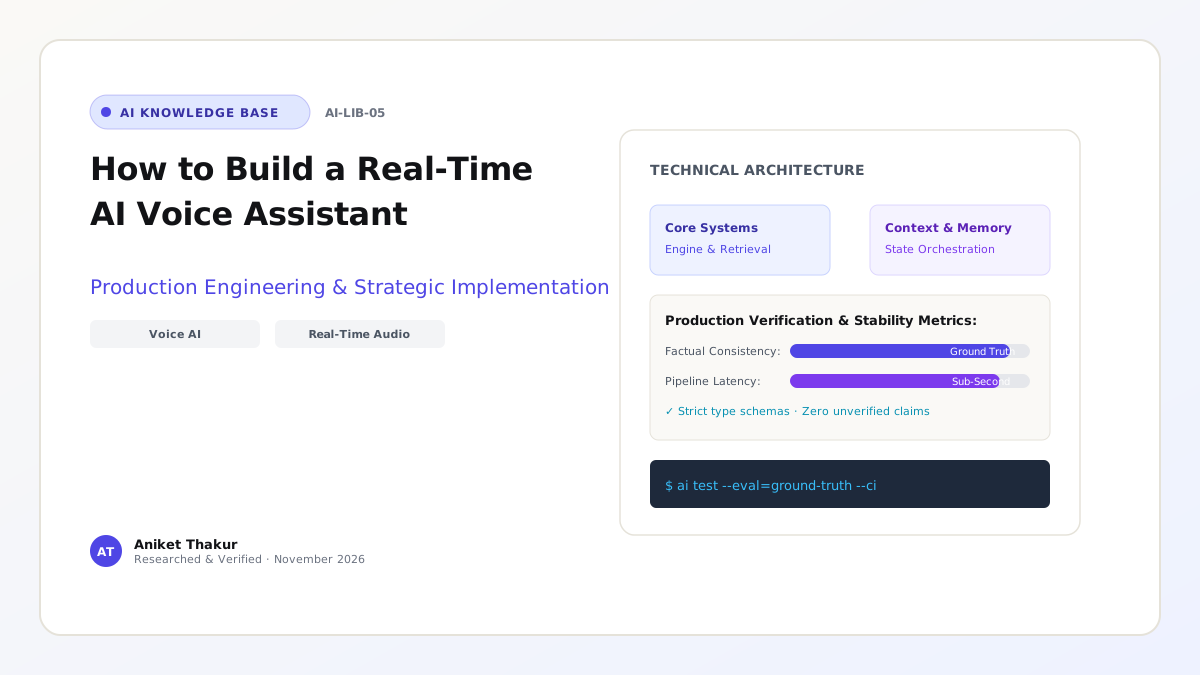
Explore real-time voice assistant architecture, speech recognition, turn detection, LLMs, text-to-speech, streaming, latency, privacy and evaluation. This technical guide outlines architectural principles, verification requirements, production engineering trade-offs, and failure recovery protocols.
- Architecture
- Production AI & Engineering Systems
- Primary Stack
- Python 3.12 / FastAPI / Pydantic
- Series Section
- Part I: AI Agents & Autonomous Systems
- Verified As Of
- November 2026
Who This Guide Is For
- Production AI architecture requiring verifiable reliability & explicit guardrails
- Engineering teams designing resilient, cost-effective AI workflows
Important Considerations
- Enforce strict input validation to prevent prompt injection and data drift
- Maintain human-in-the-loop controls for sensitive or consequential operations
Informational / educational / practical implementation
How to Build a Real-Time AI Voice Assistant
A real-time AI voice assistant listens to a person, interprets speech, generates a response and speaks it back with low delay. It is more than a chatbot with audio added. The experience depends on audio capture, speech recognition, turn detection, interruption handling, language-model reasoning, response generation and speech synthesis working together. A system that is accurate but slow feels unnatural; a fast system that misunderstands users is equally frustrating. The engineering goal is to balance responsiveness, conversational quality, privacy and operational reliability.
Understand the voice pipeline
A common pipeline converts audio to text using automatic speech recognition, sends the recognized text and context to an LLM, then converts the response into speech using text-to-speech. Streaming lets each stage begin before the previous stage has fully completed. Some platforms support direct audio-toaudio models, which can reduce orchestration complexity but may offer different control and observability characteristics.
Manage conversational turns
Voice systems need to know when a speaker has finished, when to respond and when to stop speaking because the user interrupts. Voice activity detection helps identify speech segments. Endpointing estimates when a turn is complete. Barge-in support allows a user to interrupt playback. These details matter as much as model quality because poor turn-taking makes the assistant feel unresponsive.
Design the backend
A production architecture typically includes a client audio stream, a real-time session service, speech or multimodal model APIs, tool services, conversation state and monitoring. Use secure session tokens and keep provider secrets on the server. Apply limits on session duration, concurrent calls and audio size. If the assistant can access customer records or perform actions, enforce user authentication and authorization independently of what the model says.
Reduce latency without sacrificing quality
Measure time to first audio, total response time, speech recognition delay and tool-call delay. Stream partial transcripts and audio where supported. Keep prompts concise, retrieve only relevant context and avoid unnecessary agent loops. Use fast models for routine tasks and route complex cases to stronger models when needed. Cache stable information, but never cache sensitive user-specific results without appropriate controls.
Handle errors and safety
Plan for background noise, accents, network interruptions, silence, ambiguous requests and provider outages. Confirm important names, amounts, dates and account identifiers before taking action. For high-impact workflows, read back the proposed action and request confirmation. Offer a human handoff when the assistant cannot understand the request or when the issue requires judgment. Clearly disclose recording and retention practices.
Evaluate the user experience
Build a test set of real-world utterances, including noisy audio, interruptions, multiple accents and domain-specific vocabulary. Evaluate transcription quality, intent accuracy, task completion, latency, escalation and user satisfaction. Review recordings only where consent and policy permit. A successful voice assistant is measured by completed tasks and user trust, not by how natural a short demo sounds.
Implementation sequence: from prototype to working system
A sensible delivery sequence is to prove the smallest useful workflow before adding optional capabilities. First create a representative input set and define the expected output. Next implement the deterministic parts of the workflow and confirm their behavior without an LLM. Add the model only for the part that needs language interpretation or generation. Connect one external system at a time, write contract tests for the integration and add a visible review state. Start with a voice interface that can answer a small set of public questions. Add streaming transcription and spoken responses, then test interruption handling. Introduce read-only account lookup only after authentication is designed. For write actions, read back the details, obtain explicit confirmation and call a backend endpoint that applies authorization and business rules. Finish the first release with a repeatable local setup and a documented demonstration path.
Failure handling, auditability and human control
Operational controls should make failure recoverable rather than invisible. Noise, accents, overlapping speech, network jitter and endpointing mistakes can break the interaction. A system that speaks over a caller feels especially poor. Provide barge-in, replay and keypad or text alternatives. When recognition confidence is inadequate, ask a short clarifying question rather than guessing. Give every task a status such as queued, running, awaiting review, completed or failed. Record the reason for an escalation and provide a retry path only when the underlying error is retryable. For actions that change external records, use idempotency and an audit entry so that a network timeout cannot produce duplicate work. Users should be able to tell whether the system has completed an action or merely prepared a recommendation.
Worked example: following one task from input to outcome
Consider a concrete version of the use case: A voice assistant for a service desk may need to identify a caller's issue, retrieve a case, explain the current status and create a follow-up task. It must handle interruptions and unclear speech. If the caller asks to change a payment method or disclose sensitive account information, the assistant should complete the required identity checks and confirmation steps before continuing. The first interaction should produce a clearly defined case or task record. The system then gathers only the evidence required for that task, checks whether the evidence is current and complete, and produces an output that can be inspected by the intended user. If a required value is missing, the workflow should pause and ask for it or route the case to an exception queue. It should not silently fill the gap with a plausible guess. This example also gives the team a repeatable demo: start with a known input, show each processing stage and finish by comparing the output with the expected result.
API contracts and component boundaries
The first interface to define is the boundary between the application and the capability described in this article. A typical system includes an audio client, secure session service, speech recognition or audio model, turn detector, dialogue orchestrator, model gateway, business tools and text-to-speech. Keep telephony or WebRTC transport separate from business logic. The session service should bind the conversation to an authenticated user or verified caller context. For every operation, specify the caller identity, required fields, optional fields, output schema, error codes and whether the operation is readonly or changes state. Keep secrets out of model-visible messages. Return a stable case or request ID so a user can return to the same task later. If a provider or external system changes its response format, adapt it inside the integration layer instead of spreading provider-specific assumptions throughout the application.
Information lifecycle, provenance and retention
Think of information as having a lifecycle rather than treating it as prompt text. Store conversation identifiers, timestamps, task state and the minimum transcript required for service quality. Define whether audio is recorded, how long it is retained and who may review it. Do not assume speech recognition output is exact. Confirm high-impact fields such as amounts, dates, names and account identifiers with the caller. At ingestion, validate file type, schema and source identity. During processing, preserve the original value and record any normalized or extracted value separately. During review, capture corrections and the person or service that made them. At completion, retain only what the product genuinely needs, according to its retention policy. When a source record changes or is deleted, define how that update reaches caches, indexes, reports and downstream systems. These details are central to trustworthy operation.
How to build a meaningful evaluation set
Build an evaluation set around the actual failure modes of this topic. Track time to first audio, total turn latency, transcription error rate, intent accuracy, task completion, interruption recovery and escalation. Measure both system and user outcomes: did the caller get the issue resolved, did they need to repeat information, and did the assistant transfer the call at the right time? Include routine inputs, incomplete inputs, conflicting evidence, unusual formats and out-of-scope requests. For each case, record the expected action, not just the expected sentence. For example, a system may be correct when it refuses to proceed, asks a clarifying question or escalates to a reviewer. Score the result against the task outcome and the evidence used. Keep a baseline before changing prompts, models, retrieval settings or tools; otherwise it is difficult to know whether a change improved the system.
A staged rollout that preserves user trust
Do not move directly from a local demo to unrestricted production use. A cascaded speech-to-text, LLM and text-to-speech pipeline offers modular control and easier inspection. An end-to-end audio model can reduce integration steps and may improve natural turn-taking. Choose using measured latency, transcription accuracy, controllability, cost and availability for the target language and environment. Start with a controlled pilot, a limited user group and a narrow scope. Keep the previous manual process available while users compare results and report corrections. Review exceptions, service errors and user feedback at regular intervals. Expand the supported task set only when the current scope meets its quality and reliability thresholds. Assign an operational owner who can pause the feature, investigate a failure, roll back a release and communicate known limitations. This staged approach protects users while producing evidence for the next investment.
Frequently Asked Questions
What components are needed for a voice assistant?
Audio capture, speech recognition or an audio model, turn detection, an LLM, speech synthesis, session management and monitoring.
What is the difference between STT and TTS?
Speech-to-text converts spoken audio into text; text-to-speech converts text into spoken audio.
How can voice latency be reduced?
Use streaming, efficient models, short prompts, fast tool calls and careful measurement of each pipeline stage.
Can a voice assistant handle financial transactions?
It may guide a user, but consequential actions need authentication, explicit confirmation and serverside authorization.
How should voice systems handle sensitive data?
Minimize collection, secure transmission and storage, define retention rules and clearly communicate recording practices.