15 Real-World Applications of AI in Small and Large Businesses
Businesses use AI to improve how they communicate, analyze information, manage operations and serve customers. The most valuable applications are conn.

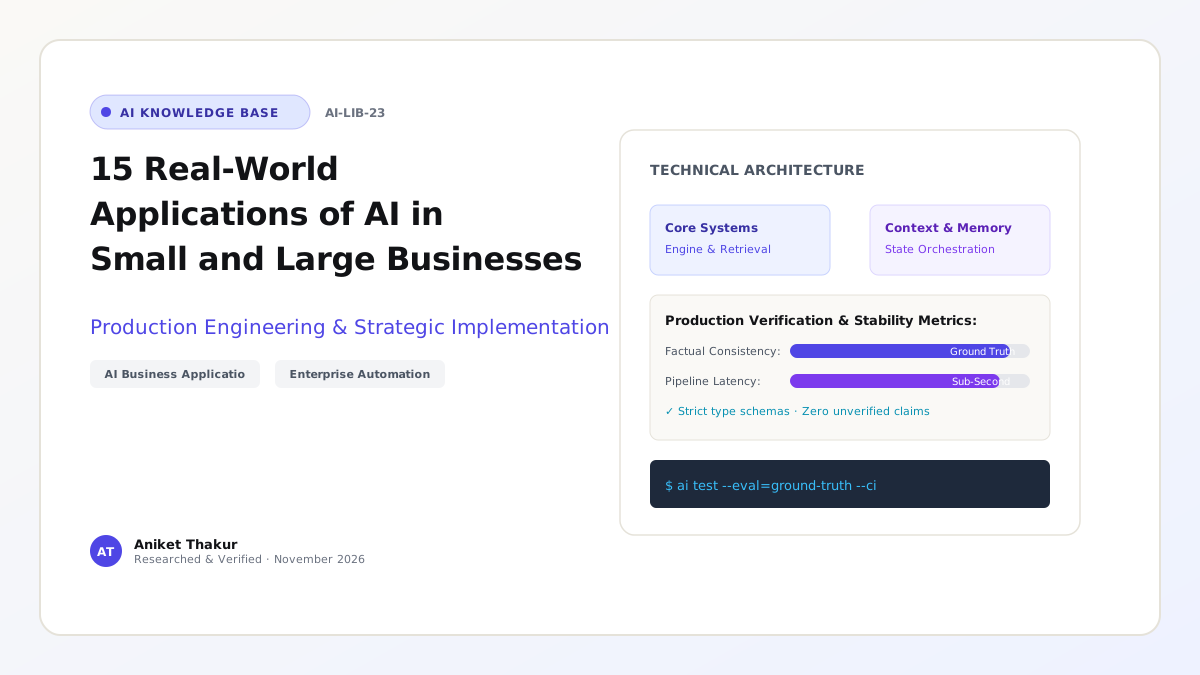
Executive summary
Overview: 15 Real-World Applications of AI in Small and Large Businesses
Businesses use AI to improve how they communicate, analyze information, manage operations and serve customers. The most valuable applications are conn. This technical guide outlines architectural principles, verification requirements, production engineering trade-offs, and failure recovery protocols.
- Architecture
- Production AI & Engineering Systems
- Primary Stack
- Python 3.12 / FastAPI / Pydantic
- Series Section
- Part IV: Industry Applications & Enterprise AI
- Verified As Of
- November 2026
Who This Guide Is For
- Production AI architecture requiring verifiable reliability & explicit guardrails
- Engineering teams designing resilient, cost-effective AI workflows
Important Considerations
- Enforce strict input validation to prevent prompt injection and data drift
- Maintain human-in-the-loop controls for sensitive or consequential operations
Informational / educational / practical implementation
15 Real-World Applications of AI in Small and Large Businesses
Businesses use AI to improve how they communicate, analyze information, manage operations and serve customers. The most valuable applications are connected to a specific business bottleneck and a measurable outcome. AI is not automatically the right answer: simpler software, better data or process redesign may solve some problems more cheaply and reliably.
How the technology works
The right design begins by identifying the task, the data it needs and the quality standard it must meet. Separate probabilistic model behavior from deterministic application logic. Keep identity, permissions, business rules and important records in systems that can be tested and audited.
How to design and implement it
Examples include customer support triage, document extraction, sales research, demand forecasting, inventory planning, quality inspection, employee knowledge search, meeting summaries, invoice matching, fraud alerts, marketing analysis, contract review, predictive maintenance, recruiting administration and software development assistance.
Practical applications
Select a use case by estimating volume, time spent, error cost, data availability and process clarity. Pilot one workflow, define a baseline and involve the people who will use the system. Integrate with existing tools and create an exception path. Scale only after quality, security and adoption are demonstrated.
Risks, limitations and governance
Common mistakes include buying tools before defining the problem, automating broken processes, ignoring data access and measuring only activity. Track business outcomes such as turnaround time, rework, cost per case, customer satisfaction and error rates.
A practical adoption roadmap
Begin with a narrow, measurable use case. Define users, data sources, expected outputs and failure conditions. Build a small prototype, test it against representative cases and involve the people responsible for the workflow. Add security, monitoring and documentation before expanding. Treat model and prompt changes as software changes that require regression testing.
Conclusion
The long-term value comes from solving a real problem reliably. Start with a clear scope, choose methods that fit the task and measure outcomes. Keep people accountable for high-impact decisions, make limitations visible and improve the system using evidence from actual use.
Implementation sequence: from prototype to working system
A sensible delivery sequence is to prove the smallest useful workflow before adding optional capabilities. First create a representative input set and define the expected output. Next implement the deterministic parts of the workflow and confirm their behavior without an LLM. Add the model only for the part that needs language interpretation or generation. Connect one external system at a time, write contract tests for the integration and add a visible review state. Score candidate processes by frequency, time consumed, cost of error, data availability and how clearly success can be measured. Pilot the highest-value, lowest-risk process. Create an as-is and to-be process map, build a minimal integration and compare against a baseline. Expand only after users trust the results and exceptions are handled. Finish the first release with a repeatable local setup and a documented demonstration path.
Failure handling, auditability and human control
Operational controls should make failure recoverable rather than invisible. A common mistake is to buy a tool before understanding the process. Other failures include automating an exception-heavy workflow, neglecting staff training and assuming that a high model score equals business value. Ensure that users can challenge outputs and that the workflow has a fallback when the AI service is unavailable. Give every task a status such as queued, running, awaiting review, completed or failed. Record the reason for an escalation and provide a retry path only when the underlying error is retryable. For actions that change external records, use idempotency and an audit entry so that a network timeout cannot produce duplicate work. Users should be able to tell whether the system has completed an action or merely prepared a recommendation.
Worked example: following one task from input to outcome
Consider a concrete version of the use case: A small business may want to classify incoming leads, summarize sales calls, draft customer replies and forecast inventory. A large enterprise may need document review, compliance triage and knowledge search across departments. The technology categories overlap, but data governance, integration complexity and approval requirements differ substantially by organization size. The first interaction should produce a clearly defined case or task record. The system then gathers only the evidence required for that task, checks whether the evidence is current and complete, and produces an output that can be inspected by the intended user. If a required value is missing, the workflow should pause and ask for it or route the case to an exception queue. It should not silently fill the gap with a plausible guess. This example also gives the team a repeatable demo: start with a known input, show each processing stage and finish by comparing the output with the expected result.
API contracts and component boundaries
The first interface to define is the boundary between the application and the capability described in this article. Organize use cases around workflow boundaries. Each workflow needs a trigger, approved data sources, model or rules component, validation, human review and a system of record. Connect services through documented APIs or managed workflow tools. A shared identity, logging and policy layer helps prevent each team from creating an isolated and insecure AI integration. For every operation, specify the caller identity, required fields, optional fields, output schema, error codes and whether the operation is read-only or changes state. Keep secrets out of model-visible messages. Return a stable case or request ID so a user can return to the same task later. If a provider or external system changes its response format, adapt it inside the integration layer instead of spreading provider-specific assumptions throughout the application.
Information lifecycle, provenance and retention
Think of information as having a lifecycle rather than treating it as prompt text. Small teams may start with spreadsheets and SaaS APIs; enterprises may have data warehouses, ERPs and identity systems. In both cases, identify the authoritative source for each fact. Avoid syncing unnecessary personal data. Make ownership and freshness visible, and apply access controls consistently across connected systems. At ingestion, validate file type, schema and source identity. During processing, preserve the original value and record any normalized or extracted value separately. During review, capture corrections and the person or service that made them. At completion, retain only what the product genuinely needs, according to its retention policy. When a source record changes or is deleted, define how that update reaches caches, indexes, reports and downstream systems. These details are central to trustworthy operation.
How to build a meaningful evaluation set
Build an evaluation set around the actual failure modes of this topic. Use metrics tied to the process: response time, conversion, forecast error, inventory stockout rate, document review time, rework, customer satisfaction or cost per case. Define a baseline and record the human effort needed to correct AI output. A useful AI pilot must improve the total process rather than one isolated step. Include routine inputs, incomplete inputs, conflicting evidence, unusual formats and out-of-scope requests. For each case, record the expected action, not just the expected sentence. For example, a system may be correct when it refuses to proceed, asks a clarifying question or escalates to a reviewer. Score the result against the task outcome and the evidence used. Keep a baseline before changing prompts, models, retrieval settings or tools; otherwise it is difficult to know whether a change improved the system.
A staged rollout that preserves user trust
Do not move directly from a local demo to unrestricted production use. Off-the-shelf tools can be suitable for common tasks, while custom systems are justified when a workflow is distinctive, sensitive or deeply integrated. Smaller businesses should avoid enterprise-scale infrastructure unless needed. Larger organizations need governance and integration standards to prevent fragmented deployments. Start with a controlled pilot, a limited user group and a narrow scope. Keep the previous manual process available while users compare results and report corrections. Review exceptions, service errors and user feedback at regular intervals. Expand the supported task set only when the current scope meets its quality and reliability thresholds. Assign an operational owner who can pause the feature, investigate a failure, roll back a release and communicate known limitations. This staged approach protects users while producing evidence for the next investment.
Prioritize business use cases by measurable economics
A practical portfolio of AI use cases should not be a list of fashionable features. Score each candidate by the volume of work, time currently spent, cost of error, data readiness, integration effort and the ability to measure an improvement. For example, summarizing a recurring internal report may be easier to validate than automating a complex customer eligibility decision. A simple rule-based workflow may outperform an LLM when the inputs and decisions are already structured. For each pilot, write down the baseline and the expected change. Identify who owns the process, who reviews exceptions and which system remains the source of truth. A small business may use a managed application with limited configuration, while an enterprise may require identity integration, audit logs and data residency review. Keep the selection process transparent so that a successful experiment can be repeated and a weak use case can be stopped without sunk-cost pressure.
Frequently Asked Questions
What is the main application?
Select a use case by estimating volume, time spent, error cost, data availability and process clarity.
How should an organization get started?
Start with a narrow, measurable workflow and test it with representative users and data.
What skills or technologies are needed?
The required skills depend on the use case, but typically include data handling, APIs, software engineering, evaluation and security.
What are the biggest limitations?
Common mistakes include buying tools before defining the problem, automating broken processes, ignoring data access and measuring only activity.
How can success be measured?
Define baseline and target metrics before deployment, then track quality, reliability, cost, latency and user outcomes.